INTRODUCTION

In the e-commerce and retail landscape, competitors' prices and stock levels fluctuate rapidly, with the same product often listed simultaneously by multiple retailers.

OPTI's client needed more than just raw pricing data from their systems. They required continuous visibility over the sources and products within the ecosystem:

  • Pricing decisions must be based on multi-criteria comparisons with competitors and suppliers to monitor margins and availability, with a keen focus on product specifications.
  • Based on the collected data, the team needs historical comparison and price-drop alerts below their own price, as well as stock-out alerts.
  • Commercial teams need unified, permission-based access to view the company's positioning relative to all market sources.

OPTI provides Google Cloud and Vertex AI services and developed a price intelligence application built on the company's data, including an AI-powered product search area and dedicated dashboards for monitoring price, stock, and margin.



Google Data Studio
Google Gemini
Price and stock monitoring - price intelligence

CHALLENGES

The application was designed as an operational layer for product intelligence. The main challenges involved the types of comparisons and the alerts needed:

1. Same product, dozens of retailers

  • A single product can appear across dozens of competitors with slightly different names. Correlation was achieved via SKU where available, or through a custom AI-driven engine for all other cases, using a confidence threshold (e.g., 95%) and human confirmation.

2. Monitoring and alerts - history of price, stock, and details

  • Price comparison is the main competitiveness metric, but some retailers express discounts as vouchers, requiring the system to calculate the final net price.
  • Stock comparison is just as important, since stock-outs lead to customers migrating to alternatives.
  • Specification-update tracking is relevant for supplier relations, allowing the team to identify feature changes or the launch of new product versions.
"We had the data, but we couldn't use it to see how supplier prices changed or how competitors were positioned. The application developed by OPTI transformed this information into a daily tool for our commercial team."
— E-commerce Manager

SOLUTION

FROM RAW DATA TO DECISIONS

OPTI built an integrated software application leveraging Google Data Studio, Google BigQuery, and Google Gemini for comprehensive product catalog monitoring:
  1. Control Center
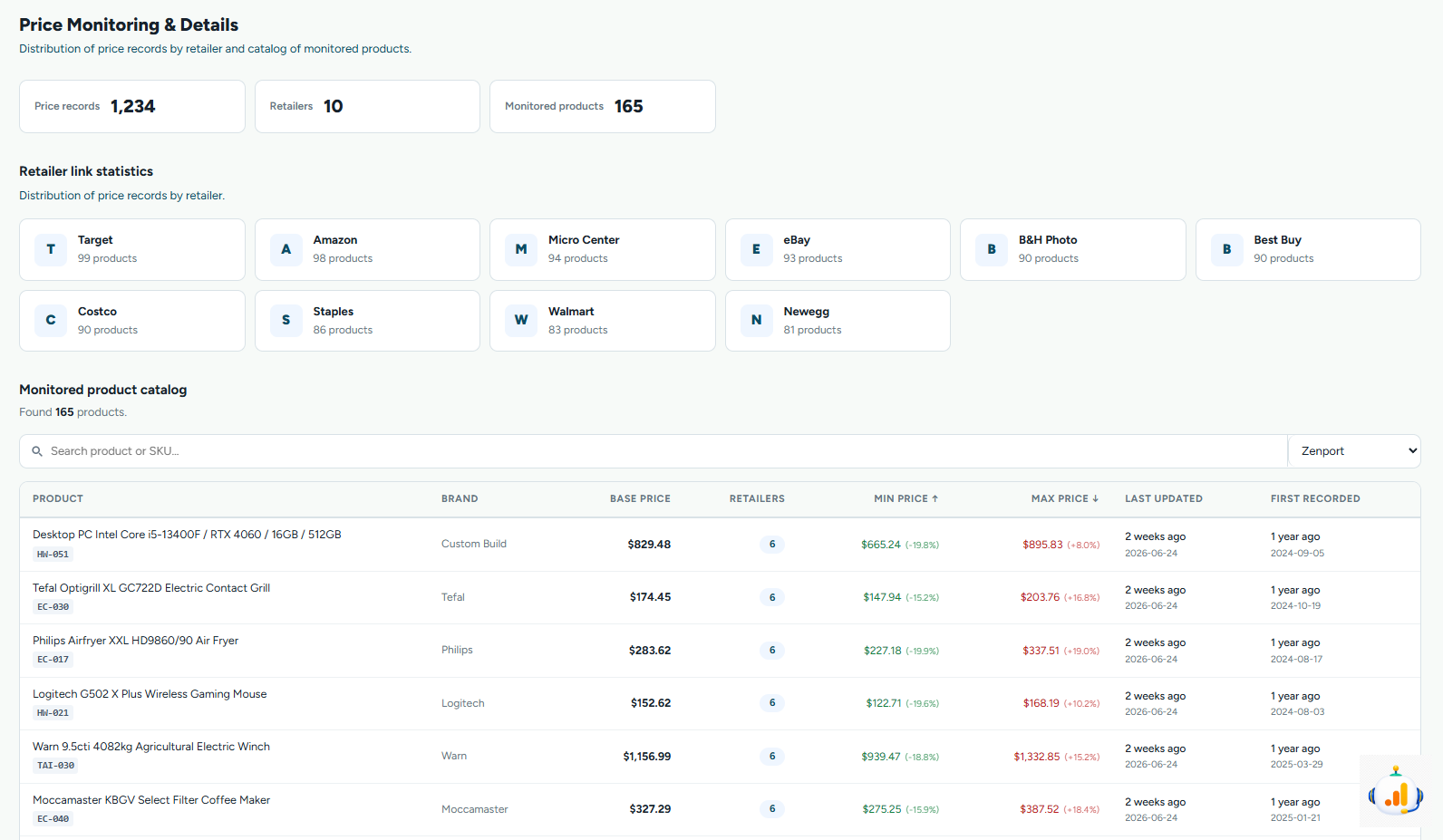
    • The central hub functions as a "command center." Instead of searching through separate files or manual reports, the user has a single interface to understand catalog size, retailer distribution, and the evolution of price, stock, and specifications.
    Central price and stock monitoring dashboard
    The dashboard centralizes the monitored catalog and offers rapid access to retailer statistics.
  2. Monitored Product Catalog
    • The catalog displays products with essential information and key actions: product name, SKU or identifier, brand and photo, base price, minimum price (includes vouchers), maximum price in a period, retailer or supplier, specification change date, last update, and alert configuration.
  3. Product Page with Prices and Retailers
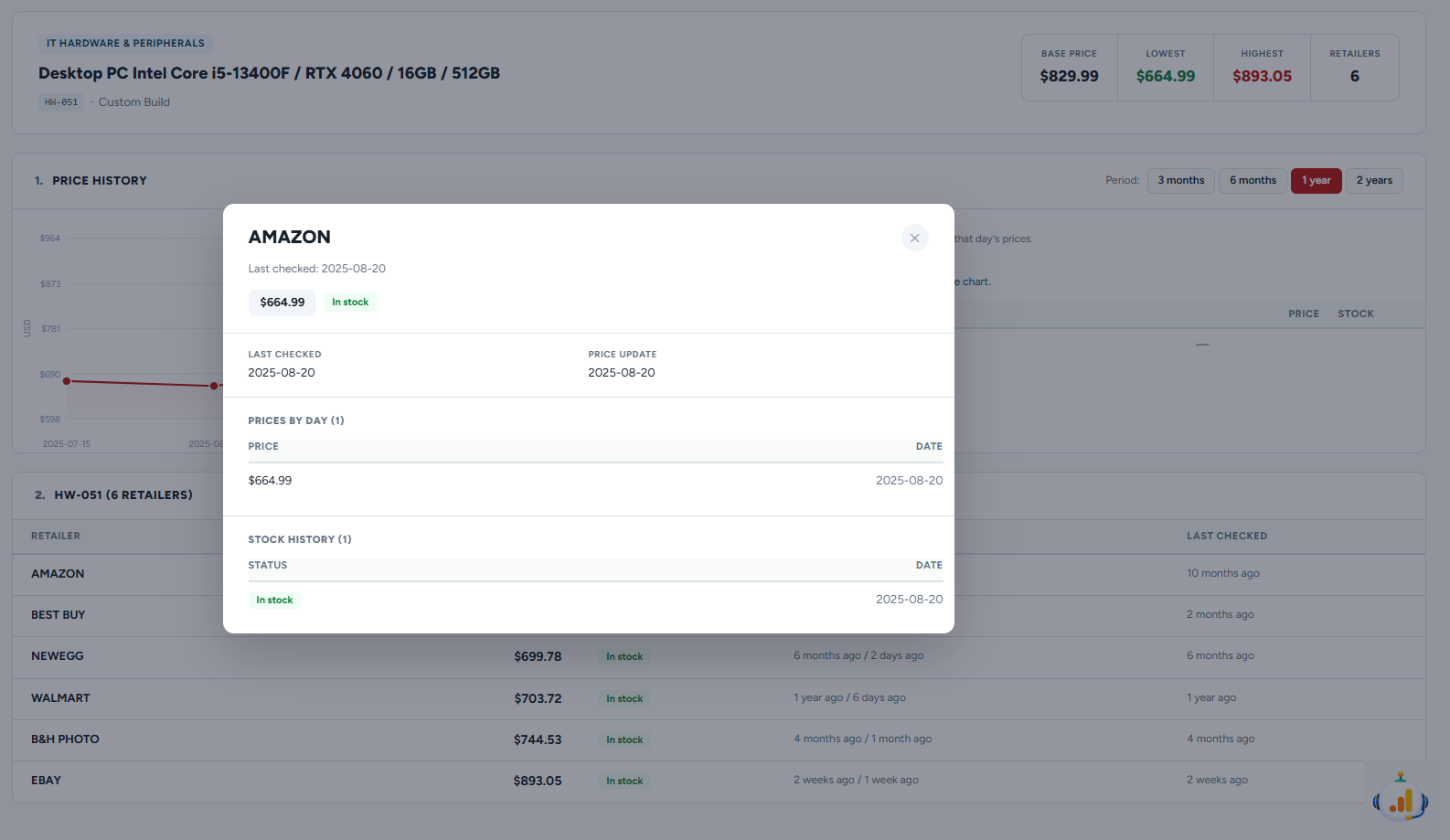
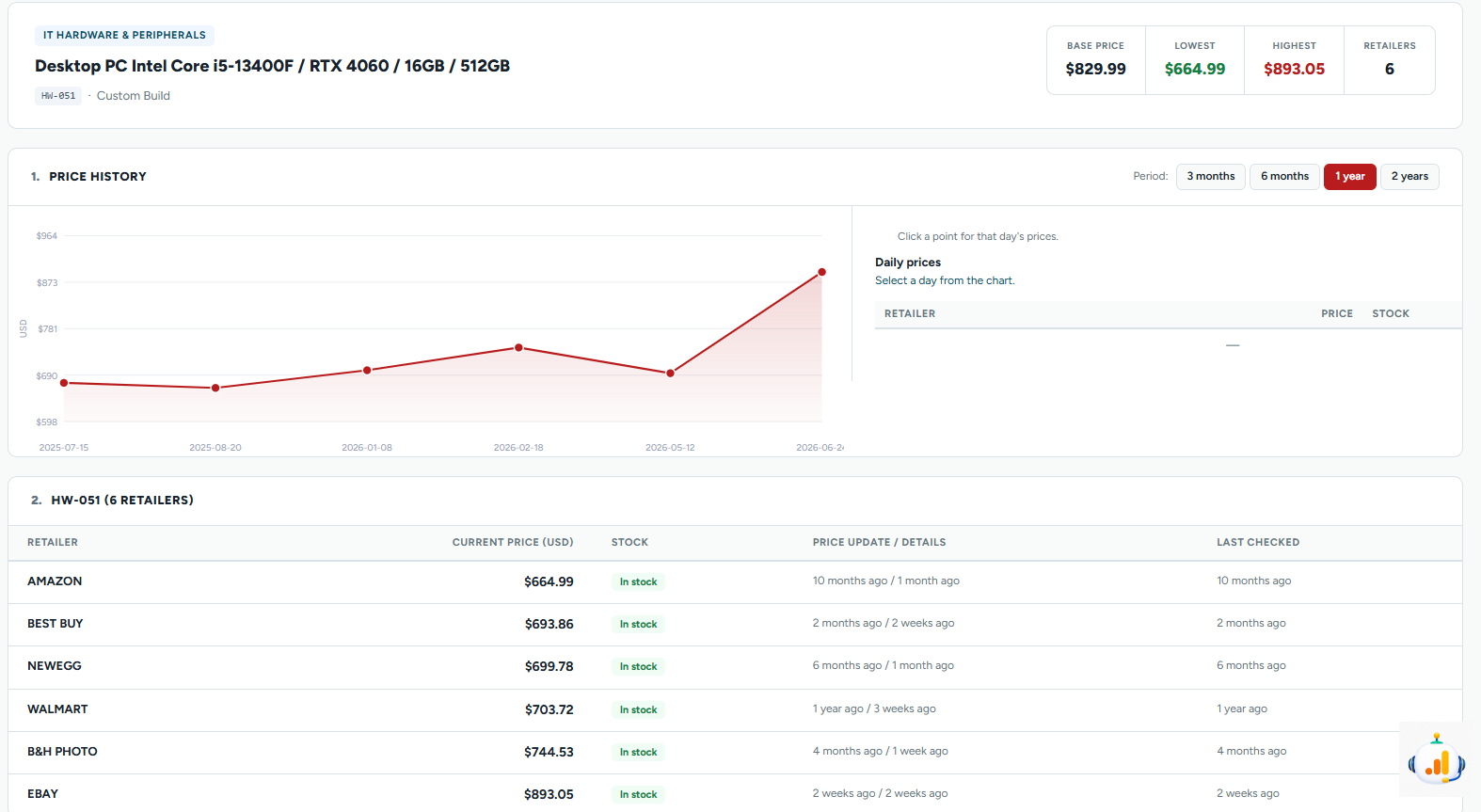
    • This page offers a complete 360-degree view of a product. For example, for a desktop computer, it displays the base price, the lowest price (including vouchers), the highest price, the monitored retailers, active alerts, and the spec update date. This allows users to grasp market dynamics instantly without navigating through multiple screens.
    Product page with prices and retailers
    The product page provides a complete view of market positioning. (Demo data)
  4. Price and Stock History with Selectable Periods
    • While a current price may seem competitive, history might reveal significant fluctuations, recent retailer price hikes, or seasonal trends. Interactive charts allow the correlation of price or stock variances with internal data to refine future pricing strategies.
    Price and stock history per retailer
    Retailer details allow for quick verification of source, price, and stock. (Demo data)
  5. AI Search and Reporting for the Entire Team
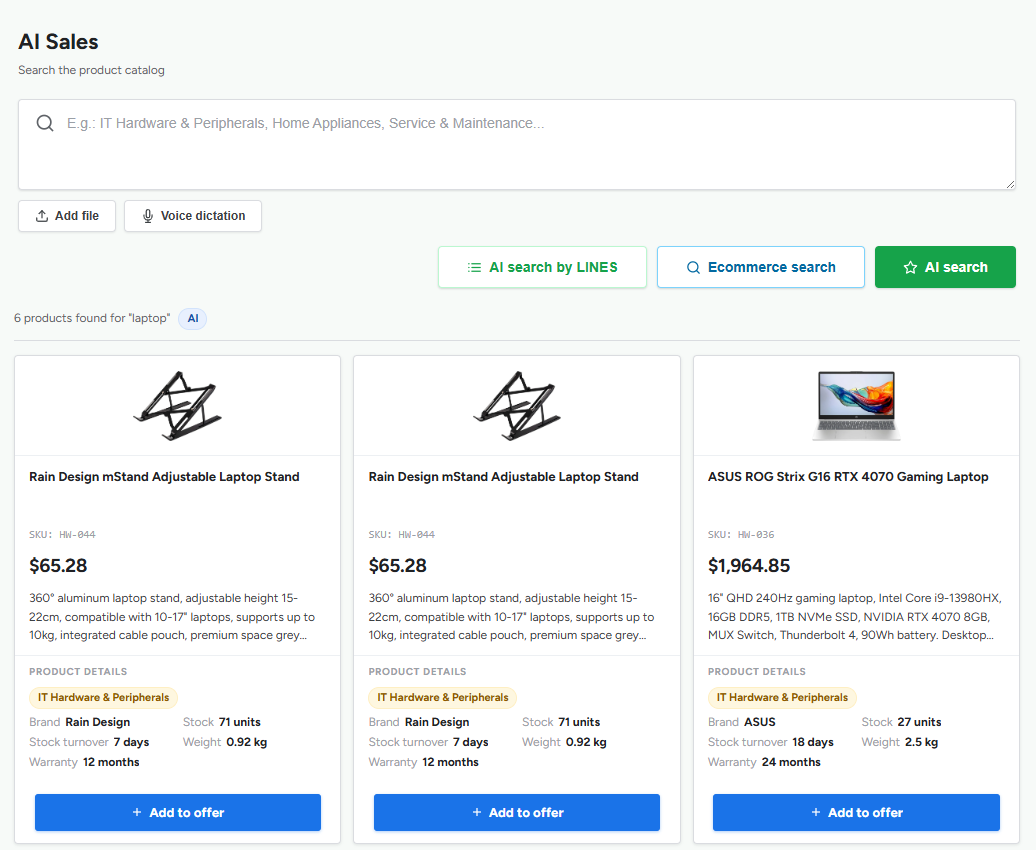
    • Beyond smart dashboards, the project includes an AI search area, integrated within AI Sales, plus a Conversational Analytics via Google Cloud zone. Users can ask questions in natural language, and the system rapidly generates custom tables, charts, and analyses based on available data.
    AI-powered product search in the monitored catalog
    Search from AI Sales finds relevant catalog products quickly. (Demo data)

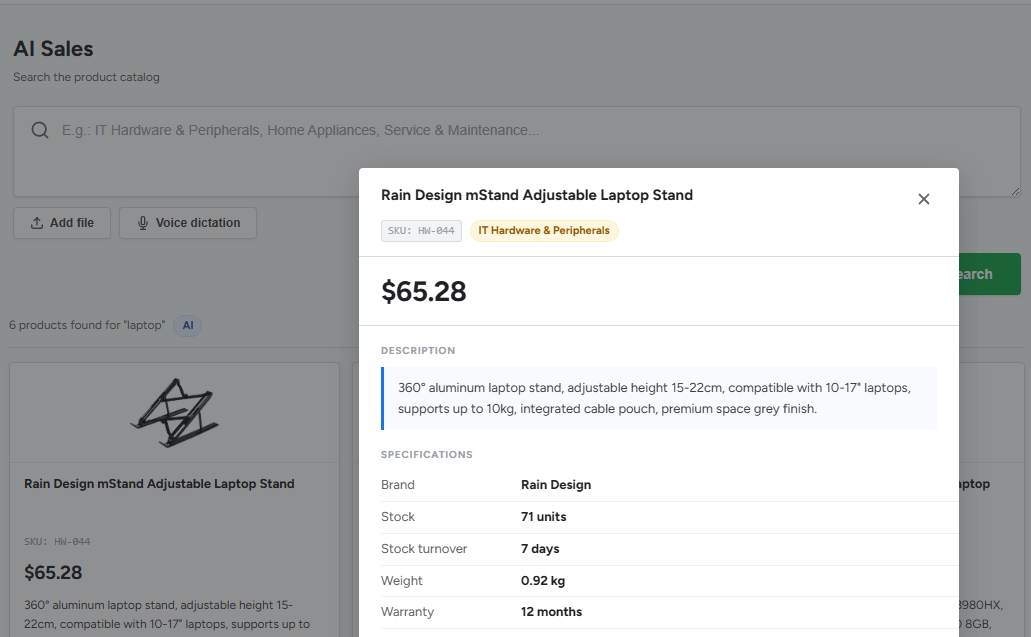
    Product detail window in AI Sales
    The details window provides instant commercial and technical info. (Demo data)

    Google Cloud Conversational Analytics for custom reports
    Conversational Analytics enables rapid custom report generation, directly in natural language. (Demo data)

*All screenshots presented in this case study come from the demo platform. Please contact us for access details.*

This case study shows that price intelligence becomes a real commercial advantage only when product correlation, price/stock history, and team access are unified in a single platform. Without this unification, commercial teams remain dependent on manual checks and spreadsheets.

ARCHITECTURE

The architecture developed by OPTI is a multi-layered workflow, ranging from client data sources to AI integration and quality control.
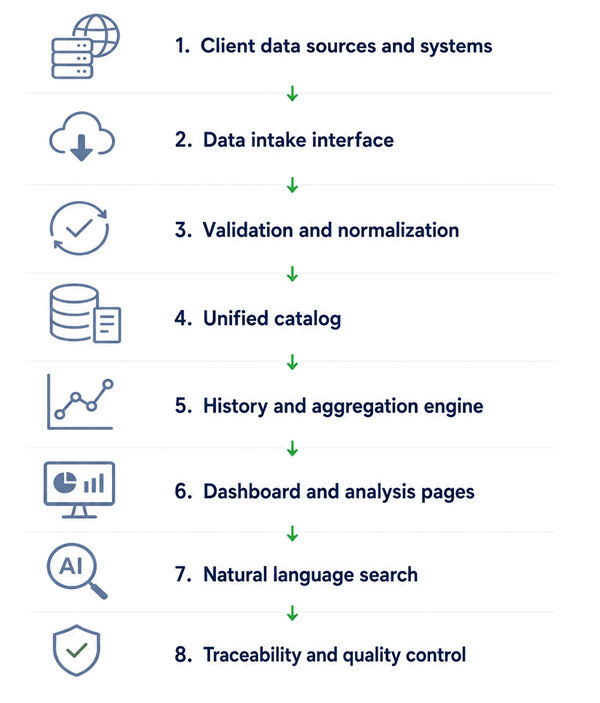
Price intelligence architecture - Google Data Studio, BigQuery, Gemini

RESULTS

AFTER 2 MONTHS OF E-COMMERCE AND B2B OPERATIONS

Full Visibility

A centralized view of 2,000 products across retailers and suppliers, including price, stock, and details.

Faster Pricing Decisions

Instant display of base, min, and max prices with % variances. Estimated analysis time reduced by 50%.

Historical Analysis

Identification of trends and seasonality, with reduced dependency on Excel.

Rapid Comparison

Real-time list of 20 retailers and suppliers with product details and commercial margins.

Traceability and Trust

Increased data confidence and rapid verification of anomalies for the entire team.

Team AI Adoption

Rapid identification of relevant products and reports without needing technical support.


Interested?

A Price Intelligence MVP can be delivered in 4-6 weeks. Let's talk.

TECH AND METHODOLOGY

  • Services: Business Analysis, Process Modeling, Architecture, Backend Development, Data Integration, Frontend Development, AI Integration, Google Cloud Integration, QA & Testing.
  • Google Cloud Tech: Google BigQuery, Google Cloud, Google Data Studio, Google Gemini, Conversational Analytics.
  • Methodology: Discovery & Objective Setting, Data Modeling (Products, SKU, History, Alerts), Main Dashboard & Sub-modules, Scheduler Engine (Normalization, Aggregation), AI Integration (Semantic Search & Conversational Analytics).
  • Standards: ISO 9001 (Quality), ISO 27001 (Information Security), ISO 42001 (AI Management).

Quick Questions

What is price intelligence and why does it matter for retail/e-commerce?

Price intelligence is the continuous monitoring of prices, stock, and product specifications across competitors and suppliers, with automated alerts. It lets commercial teams make fast pricing decisions based on real market data.

How are products matched across dozens of retailers with different names?

Matching is done via SKU where available, and through a custom AI-driven engine for the remaining cases, using a confidence threshold (e.g., 95%) and human confirmation for ambiguous cases.

Which Google Cloud technologies were used?

The application uses Google BigQuery for data, Google Data Studio for dashboards, Google Gemini for AI features, and Conversational Analytics for natural-language queries.

How long does a price intelligence MVP take to implement?

An MVP can be delivered in 4-6 weeks, covering an initial set of products and retailers, followed by expanding the catalog and alerts.

What results were achieved after implementation?

After 2 months of operation, the client gained full visibility over 2,000 products across 20 retailers and suppliers, faster pricing decisions, and reduced dependency on spreadsheets.

What is the TLDR (conclusion)?

This case study shows that price intelligence becomes a real commercial advantage only when product correlation, price/stock history, and team access are unified in a single platform. Without this unification, commercial teams remain dependent on manual checks and spreadsheets.

What technologies and methodologies are involved?

Technologies: Google BigQuery, Google Cloud, Google Data Studio, Google Gemini, Conversational Analytics
Methodologies: Discovery & Objective Setting, Data Modeling (Products, SKU, History, Alerts), Main Dashboard & Sub-modules, Scheduler Engine (Normalization, Aggregation), AI Integration (Semantic Search & Conversational Analytics)

Lucian Cârlogea

Article written by

Lucian Cârlogea

Senior Software Engineer (with OPTI since 2013). eCommerce, database and backend optimization.

See on LinkedIn →

Read More

Interested?

Want to see it in action?

Let's talk

Similar stories


Case Study: Implementing schema.org / JSON-LD for GEO (AI Search) in B2B and eCommerce
31.03.2026
Case Study: Implementing schema.org / JSON-LD for GEO (AI Search) in B2B and eCommerce
Case Study: How we built reusable semantic graphs for three websites (B2B and e-commerce) using server-side schema.org / JSON-LD, achieving more stable indexing, ~70% GSC click growth, and the first AI Overviews.
Upgrading Entersoft ERP Sales Work with AI: Cutting Quoting Time by 68% for an Industrial Distributor
15.12.2025
Upgrading Entersoft ERP Sales Work with AI: Cutting Quoting Time by 68% for an Industrial Distributor
AI-powered sales quoting platform integrated with Entersoft ERP for catalogue and stocks, reducing quote preparation time by 68%, eliminating product errors, and increasing average order value through smart search and upselling.
Case Study: E-Commerce UX & SEO modernization (Cartepedia)
24.11.2025
Case Study: E-Commerce UX & SEO modernization (Cartepedia)
Case Study: How we drove +70% traffic and +20% conversion for Cartepedia.ro through UX refactoring, technical SEO, and AI-ready architecture.

News and Guides

More News