
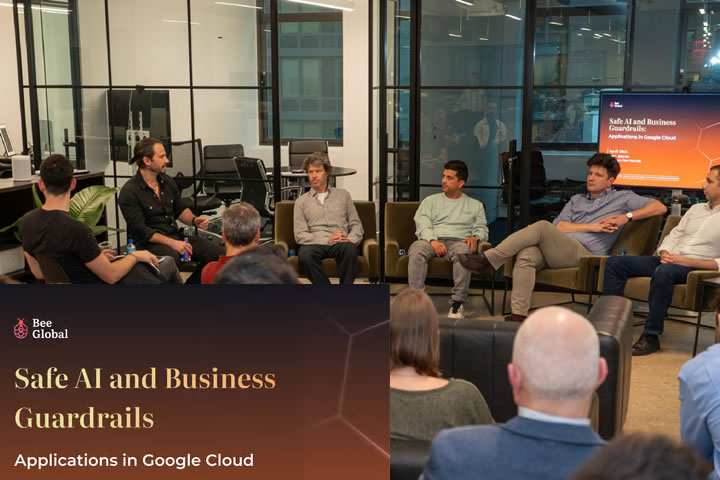


After the success of the BeeGlobal conference in March at UiPath's Bucharest headquarters, where we analyzed AI implementation from complementary perspectives (business, legal, and cybersecurity), the discussion crossed the ocean. On April 28th, we were present in New York at the "Safe AI and Business Guardrails – Applications in Google Cloud" event, organized by the BeeGlobal network in partnership with System2.
Our colleague, Marian Călborean (Founder & CEO OPTI Software), took the stage alongside other experts and technology leaders to debate the challenge of the moment: how do you turn AI from an experiment into a scalable production solution, without losing control over security and data? Since the event took place after Google Cloud Next and the latest Google Cloud releases, the technologies cited were from Google Cloud, but applicable to any other technology stack.
Why do we need rules for AI? As BeeGlobal excellently summarized in their post-event write-up:
"Good brakes are the ones that let the car go fast."
Why does AI fail in the Enterprise environment? Because it's overconfident, not because it doesn't know
One of the best summaries of the evening came from the audience, from David Wong (Technical Program Manager, former tech leader at BlackRock), who captured the ideas of the event. He pointed out an uncomfortable truth on LinkedIn:
"Enterprise AI doesn't fail because the model is wrong. It fails because the model sounds extremely confident when it is wrong."
When we talk about regulated industries or B2B, "AI hallucinations" cannot be accepted, for example for financial data. For this reason, all innovations in AI safety are centered on the need to make AI more deterministic (predictable, precise, constrained by rules).
How do we achieve this? During the panel, Marian Călborean pointed out that the secret lies in the data foundation on which AI agents are built: a strong Knowledge Graph and a well-defined Semantic Layer.
The OPTI Solution: Build a Semantic Layer before AI agents
Don't let agents search for (and invent) answers from scratch. If you want to prevent hallucinations in generative AI models, or the "drift" phenomenon in Machine Learning, information must first be structured according to the organization's real business processes.
As happens with giants like Palantir, success lies in a robust knowledge graph:
When you process a company's data (for example, a Pharma/Medical company), organizing information by department, active substances, or strict business processes forces AI agents to navigate in a way that is close to the company's logic.
The result is a drastic reduction in hallucinations, as Marian detailed:
Four iron rules for safe AI, drawn from the panel
The discussions in Manhattan, moderated by Troy Johanson (System2), revealed strategies tested in production by the other panelists: Seth Leonard (System2), Sanjay Mishra (Fidelity Investments), and Gabriel Păunescu (NauLogic).
We noted a few basic ideas that every B2B company should apply:
- Never let AI "touch" the numbers: Separate the narrative thread from the numerical data. The LLM can write the summary or interpretation, but traditional (deterministic) code must inject the financial figures. This avoids major legal risks.
- Ensure audit and logging capabilities: In regulated industries, an answer provided by AI has no value if you cannot document the path through which it was reached.
- Route intent before the query: Use deterministic routes (soft stops) before the user's prompt actually reaches an LLM, to block unsafe requests from the start.
- Treat prompts like pieces of code: Avoid long conversations that make the model lose context. Segment tasks and use structured formats.
In the end, Marian summarized the Semantic Layer concept as a solution for data traceability and accuracy:
Conclusion: AI determinism is the essential requirement
The step from isolated experiments to integrating AI into real processes, from generating complex quotes to decision-making analysis in business, runs into a "trust architecture" problem. The solutions above are the most advanced at this time.
We invite you to read David Wong's detailed perspective on the event, together with the LinkedIn discussion that followed. This confirms the quality principles adopted by OPTI Software: hybrid architectures, predictability, and B2B safety.
To dive deeper into how you can practically implement these architectures in your company, we invite you to download our free material: Guide #1 in the AI Architecture Series for B2B 2026: Smart Recommendations, Upsell, and Rules.
Contact us for an in-depth discussion of your business scenario