


In B2B sales, the role of a Next Best Action module using artificial intelligence is to tell the sales agent what to do at each step. Call the customer? Send a quote? Propose a replenishment or a complementary product added to the order? In essence, it is a step-by-step seller.
A "step-by-step" module transforms data from ERP, CRM, e-commerce and, above all, the company's experience, into a logical sequence of steps for the sales agent.
In the OPTI Guide on AI recommendations, upsell and cross-sell in B2B, we showcased projects that identify relevant products for a customer, but NBA extends this capability by recommending each concrete action within the company's customer sales cycle.
1. Specific B2B Actions, Recommended with Precision
In e-commerce or B2C, a product recommendation may be sufficient, but in B2B, sales take into account order history, framework contracts with negotiated prices, credit limits, outstanding payments, logistical conditions (delivery from a specific warehouse within a certain time), technical compatibility, or seasonal budgets, which are not visible in a simple catalog.
A B2C recommendation module asks "What product might the customer buy?"
A Next Best Action module says: "Call the customer today. The last order was 42 days ago, estimated consumption indicates replenishment within the next week, product Y is compatible with previous purchases, stock is available, and the maximum allowed discount is 5%."
Examples of step-by-step actions:
| Call for replenishment | |
| Propose complementary products | |
| Propose a bundle | |
| Send technical documentation or catalogs |
The challenge and opportunity lie in adapting to the company. A good Next Best Action system generates few but highly relevant actions and notifications. Otherwise human agents will prefer their own experience and it will not help them.
What does a recommended action look like in the CRM?
Next Best Action cards can be placed in the company's CRM next to each customer, lead, or opportunity. They must answer four questions for the sales agent:
- What do I need to do?
- Why now?
- What commercial offer should I propose?
- What contractual or commercial constraints must I respect?
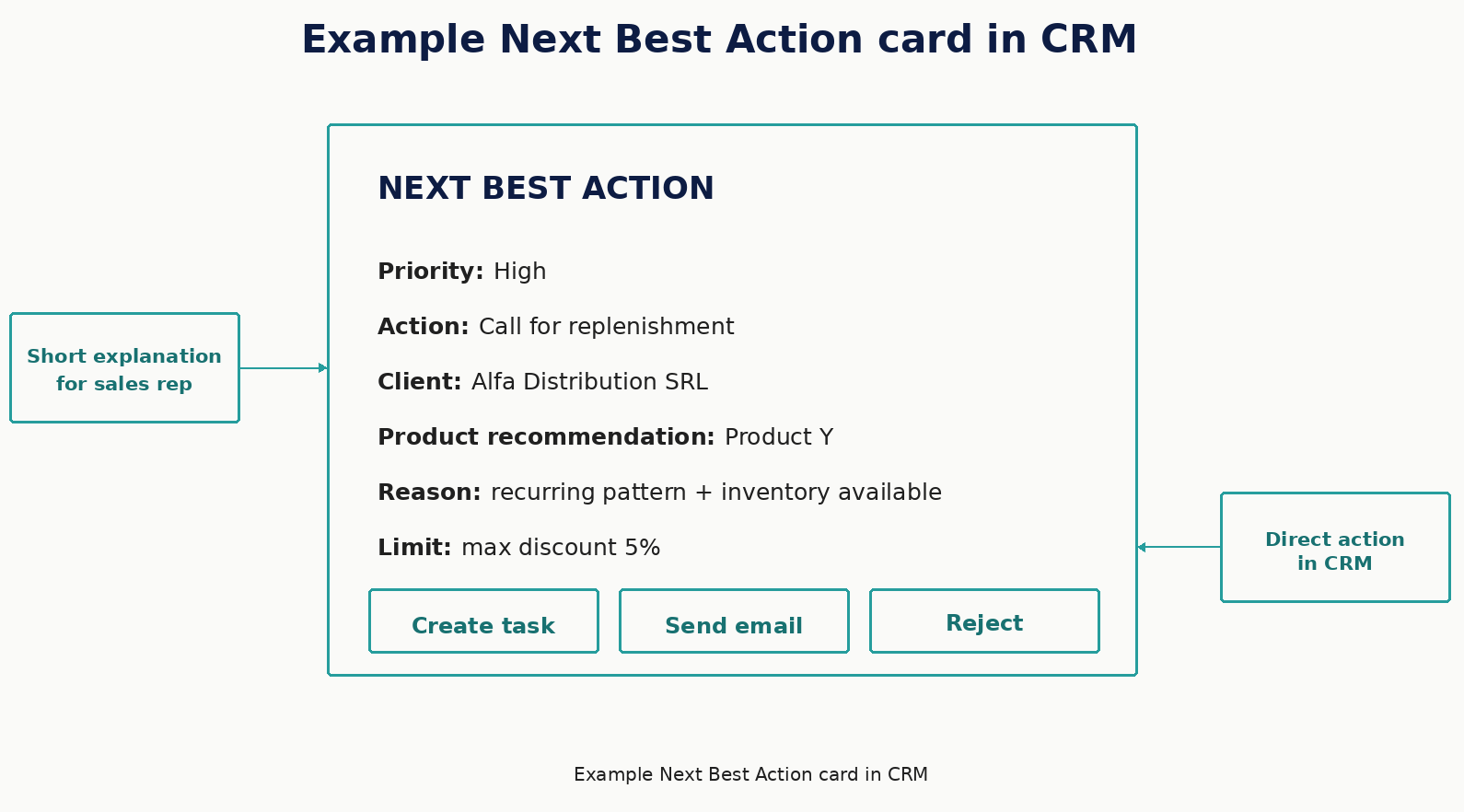
Detailed example:
Customer: Alfa Distribution SRL
Recommended action: Call for replenishment
Why:
- Last order was 38 days ago.
- Order history indicates a new order every 35-45 days.
- The main product is in stock.
- The customer has previously purchased products compatible with the new recommended bundle.
Proposal:
- Product A: replenishment
- Product B: compatible cross-sell
- Recommended bundle: A + B
Rules:
- Maximum discount: 5%
- Do not propose extended payment terms.
- Minimum margin must be kept above the internal threshold.
Short phone script:
"Good morning, I noticed you are approaching your usual replenishment period for Product A. We have stock available and I can also send you a bundle option with Product B, compatible with your previous orders."
The sales agent receives from the software a logical recommendation, with an explanation and explicit limits, which makes their work easier.
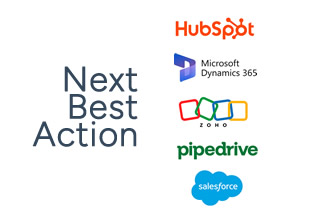
For an direct implementation in an CRM, we compared separately the Next Best Action functions available in HubSpot, Dynamics 365, Salesforce, Zoho and Pipedrive
Which industries does it fit?
Distribution, including medicalA distributor, including pharmaceutical, has hundreds or thousands of products and customers who order regularly. The system can identify a missing expected order, propose replenishment, and suggest complementary products. Recommended
action: |
ManufacturingA B2B manufacturer can use NBA for follow-up on technical quotes, compatible products, or consumables associated with delivered equipment. Recommended
action: |
Professional servicesA services company can use NBA for renewals, subscription expansions, audits, or additional packages. Recommended
action: |
B2B e-commerceA B2B portal contains product recommendations for the customer, but the sales team can give special treatment to high-value customers. Recommended
action: |
2. How Do You Ensure Quality? Through Hybrid Architecture: AI Proposes Based on Company Data, but Rules Decide
With secure access to company data, AI can identify opportunities, make predictions, and generate intelligent explanations. But the recommended action must always be verified through strict business rules (guardrails).
AI proposes. Business rules decide what reaches the agent
The essential rules for almost all B2B companies include respecting margin, stock, overdue payment policy, maximum discount, and contractual specifications.
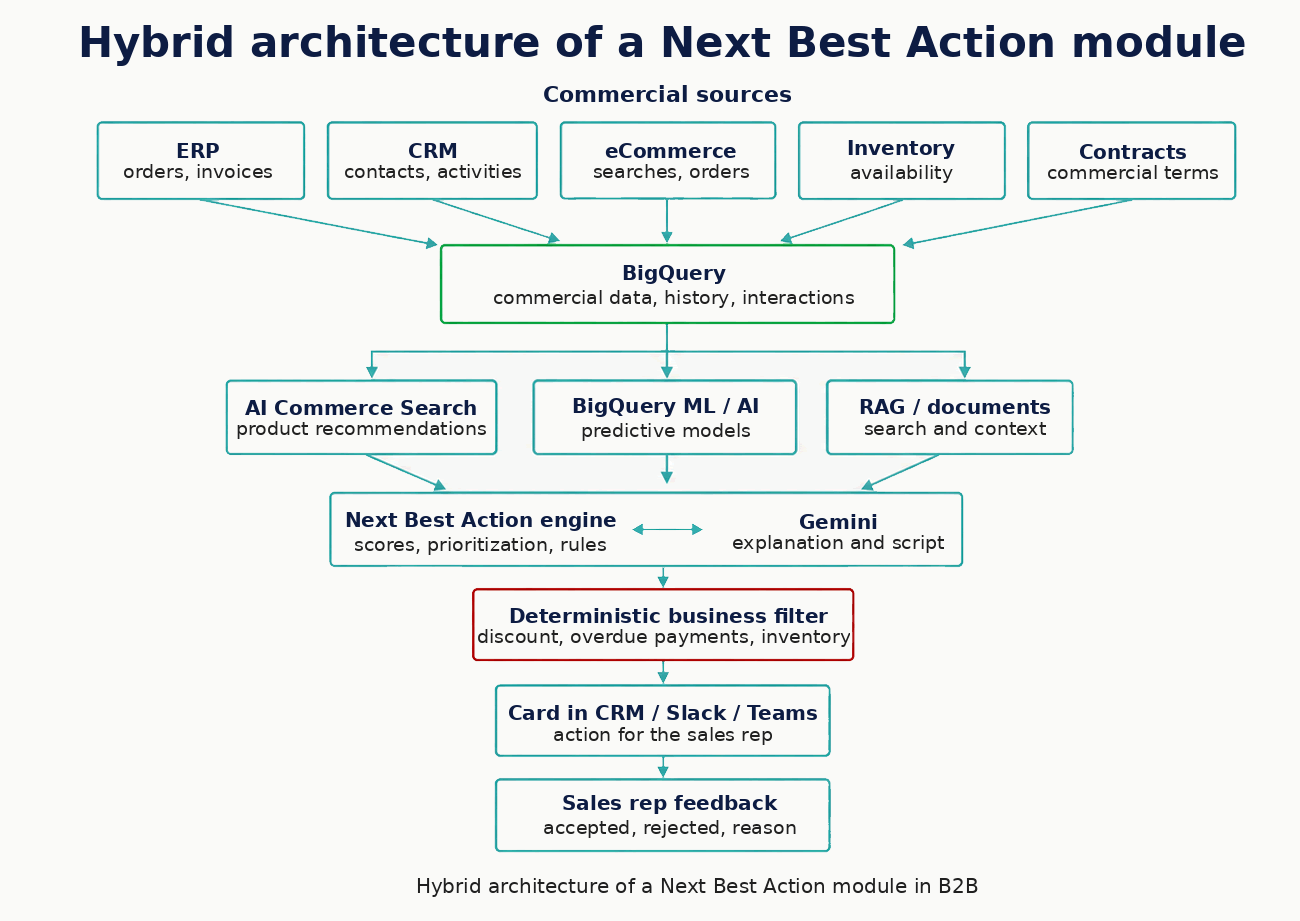
For this reason, the recommended architecture looks like this, starting from data, passing through AI, and applying the company's rules:
Two common mistakes
The first mistake is treating AI as an autonomous engine that always decides on its own what needs to be done. In B2B, this is very risky.
The second mistake is keeping AI only at the reporting level. If the system only shows charts and intelligent scores, the agent still has to manually interpret them.
See special protections in Google Cloud for companies using LLMs
Clean data ensures the precision of the recommended action
An NBA module translates data into actions, so quality starts with data and only then do LLM prompts and AI technologies in general start to matter.
The most important data sources in B2B:
- ERP: orders, invoices, products, prices, margins, payment terms
- Product catalog: categories, compatible products, substitute products
- Stock / WMS: availability, excess stock, slow-moving products
- CRM: pipeline, contacts, companies, activities, emails, notes, calls
- Contracts: special conditions, negotiated prices, approved discounts
- Service / support: tickets, complaints, recurring issues
- Marketing: campaigns, engagement, forms, pages visited
- Internal documentation: technical datasheets, manuals, delivery conditions
It is important that data is interoperable and standardized. You need an intermediary layer in the data warehouse, which should include both a copy of data from different systems and data quality rules, so that the architecture holds up in the long term. It will look like this:
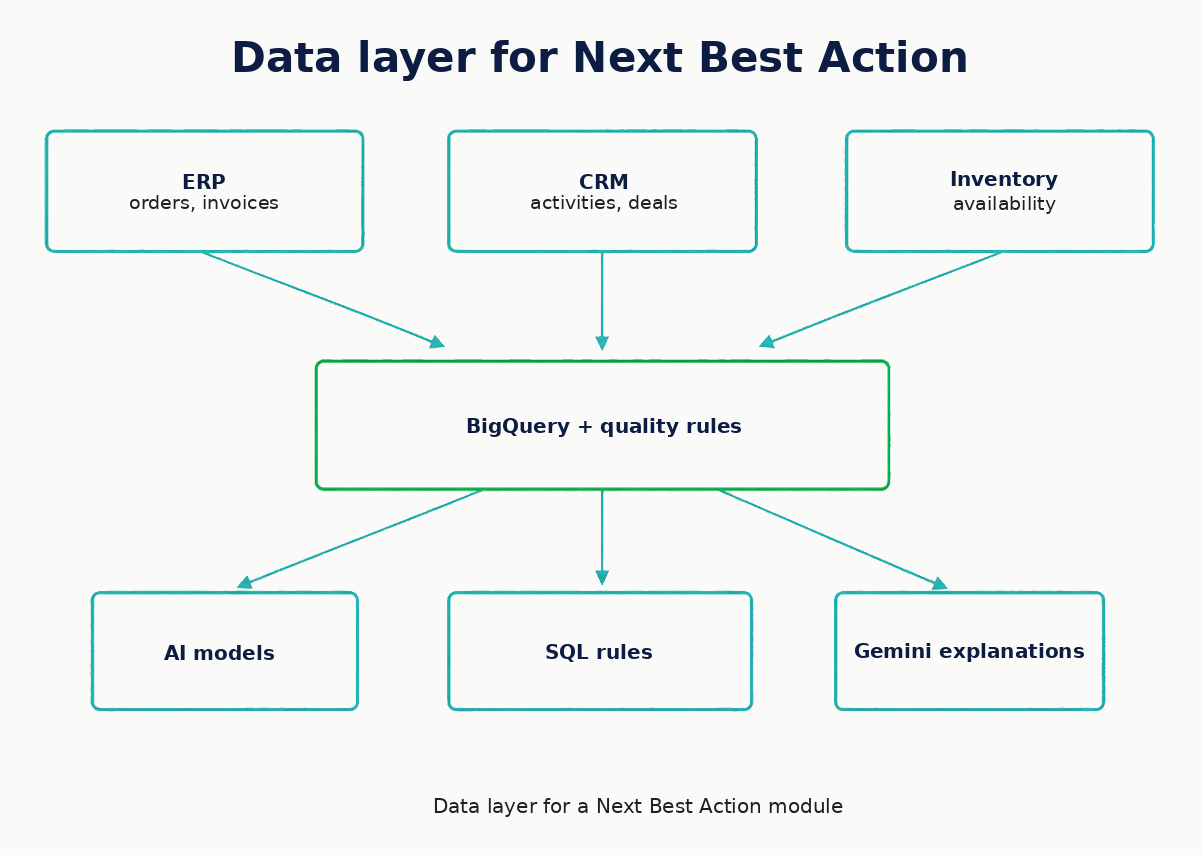
In Google Cloud, BigQuery is usually at the center of this data architecture. Data is only copied for analysis, with BigQuery functioning as the common analytics layer. All commercial data is brought in, SQL transformations are applied, and BigQuery ML models and AI functions are connected on structured or semi-structured data.
See data analysis in Google Cloud with BigQuery and Data Studio
Success is ensured through this solid foundation on which AI will then operate.
3. From the Product Catalog to the AI Explanation for the Sales Team
Product recommendations: what the customer might buy
The first intelligent layer will be the product engine. The functions available for products in NBA software can include:
- products frequently bought together
- similar products
- complementary products
- products suitable for the customer's history
- products recommended based on customer segment
- products with available stock or priority rotation
- alternatives for unavailable products
In Google Cloud, the AI Commerce Search (Vertex AI Search for commerce) product can be used for commercial search and recommendations, especially where there is a catalog, customer interaction events, and a rich purchase history.
In B2B, however, this recommendation must be adapted. An industrial customer does not buy the same way as a final consumer in B2C, and above all, essential commercial rules apply in B2B.
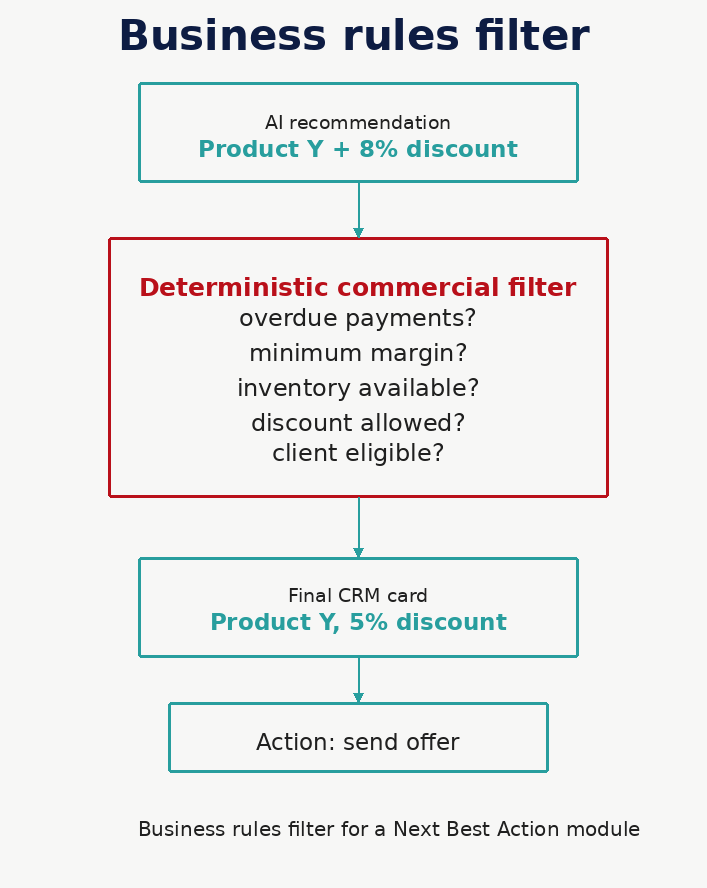
Rule application example
Initial AI recommendation:
Product X + Product Y + Product Z
Business filtering rules:
- Product X: removed, insufficient margin with the customer's discount.
- Product Y: accepted, compatible and available in stock.
- Product Z: accepted only for quotes without extended payment terms.
Output to agent:
- Main recommendation: Product Y
- Alternative: Product Z, with standard payment conditions
For this reason, a Next Best Action is more than a product recommendation engine. The recommendation is just one of the system's inputs; the recommended actions will vary depending on the specifics of each company and its customers.
The right moment: when it makes sense to act
A good recommendation sent too early may seem aggressive. The same recommendation sent too late may lose the order. Therefore, a Next Best Action module must estimate the right moment from the signals available in the data sources and the recommendations of CRM systems like HubSpot. A few examples:
- The customer orders every 30-45 days
- Estimated consumption indicates stock depletion
- The sent quote has not received a response in 7 days
- The contract is approaching renewal and the customer has been recently active
- Internal stock must be rotated before a certain date
- Some products are seasonal or on promotion, including bundles
- The customer has started buying from a competitor (if you have data)
For such scenarios, technologies like BigQuery ML (with AI.GENERATE, AI.SEARCH, and AI.FORECAST functions) and AI functions in BigQuery can be used for classification, scoring, time forecasting, or time series analysis.
Simple example of combining signals with AI functions for NBA
Conditions:
- the customer has a history of at least 4 orders,
- the average interval between orders is 35 days,
- 32 days have already passed since the last order,
- the product is in stock,
Recommended action:
"Call for replenishment within the next 3 days."
As the system receives feedback from the team and ultimately from customers through purchases, the rules can be refined in more detail or replaced by automatic predictive models.
The recommended action now: what the team must do based on the rules
Once we have the products and the analysis of the right moment, the system must choose the action. This correlative table of recommended action vs. ideal situation can help, which you can supplement based on company experience.
| Recommended action | Ideal situation |
|---|---|
| Call for replenishment | Customer with a recurring order rhythm |
| Contact for retention | Customer with churn risk |
| Propose complementary products | Customer with a recent order |
| Send follow-up | Quote without response |
| ⛔ Resolve financial overdue | Customer with outstanding payments |
| Propose a bundle | Unavailable products or low margin |
| Schedule renewal discussion | Contract close to expiry |
| Send technical documentation or catalogs | Customer with high volume and good margin |
| Escalate to manager | Strategic customer |
| ⏸️ Do not send notification | Weak signal, do not waste effort |
This list must be configured together with commercial management. AI can suggest patterns, but the company must decide which actions are acceptable. In particular, the action must cover at least the current commercial activity, so the module is an upgrade.
Here too, we must protect the company and its image through two levels of explicit rules (guardrails).
a) Deterministic business rules
These are applied in SQL, code, or a policy engine (rules engine). They must not be left to the interpretation of the LLM model. Examples:
- If there are overdue invoices over 30 days, recommend a payment clarification action
- If the estimated margin is below the minimum threshold, remove the recommended product
- If there is no deliverable stock, remove the product and propose a compatible alternative
- If the product is not approved for the customer's segment, send a request for inclusion in the segment
These rules are auditable and under commercial management's control. They are reflected directly in the NBA with explanations, so the team knows why a product was proposed or removed.
b) Guardrails for the generative LLM model
To avoid sensitive data leakage, block prompt injection attacks or unauthorized use (e.g.: scheduling a website in the company's chatbot), and control the company's data sent to AI, it is recommended to filter the input and output of LLMs.
See how Model Armor and agentic AI governance mechanisms can be used to control LLM interactions.
The action explanation: how the agent knows what to discuss with the customer
AI can explain, even if it does not decide on its own, why a customer receives a discount, if a product is being proposed, or if a payment overdue is being deferred. These decisions are controlled through data and deterministic rules, as shown above, but the agent must know what to discuss with the customer. AI is excellent at explaining a situation in easy-to-understand language.
The role of an LLM like Gemini is best suited for synthesis, explaining to the agent why the recommendation appears. It is also excellent for formulation, proposing a message, email, or short phone script, and for context: extracting information from documents, CRM notes, technical datasheets, or commercial policies, for example through a chatbot attached to the sales software.
LLM role example:
Customer: Alfa Distribution SRL
Last order: 38 days ago
Average interval between orders: 41 days
Recommended product: Product Y
Recommendation reason: compatible with the previously purchased product
Risk: customer with average margin, no outstanding payments
Rules: maximum discount 5%, do not promise delivery in under 48h
Recent CRM interactions:
- the agent discussed portfolio expansion
- the customer requested a technical datasheet
- no open complaints
LLM explanation for agent:
The customer is close to their usual replenishment interval. Product Y is compatible with the previous purchase and can be proposed as a natural extension of the order. Do not exceed the 5% discount and do not promise delivery in under 48h.
Proposed LLM script:
"Good morning, I am calling back because you are approaching your usual replenishment period. We have Product Y available, compatible with your previously ordered products. Can I send you a short proposal?"
Human feedback: how the system improves
The sales agent must be able to indicate: whether the recommendation was accepted, whether it was wrong and especially why (unsuitable product, wrong timing, customer already contacted). Additionally, in the CRM you will track whether the sale was ultimately recorded or the opportunity was lost. This feedback is essential for the system to permanently adapt to the reality of the sales cycle.
4. The Secret to Success: CRM Integration and Control of the Entire Operational Flow
Principle 1: The recommendation will be delivered where you already work
From experience, a Next Best Action module has value when the recommendation is delivered where the agent already works:
For example in HubSpot, as an App Card / UI extension on a company, contact, or deal. Or in Salesforce, as a component on the account or opportunity page.
If urgent alerts are needed, they can appear in Slack or Microsoft Teams. And when the team is disconnected or in the field, the solution can be integrated into the internal portal, the SFA solution used, Slack, or even WhatsApp for field teams.
Principle 2: Control of the entire operational flow, at IT and Management level
A simplified flow for all the aspects presented above is:
- The system updates commercial data in the data warehouse (BigQuery) from data sources
- Signals are calculated: recurrence, churn, stock, margin, opportunity
- The recommendation engine identifies relevant products
- The action engine decides the type of recommendation
- Business rules eliminate impermissible recommendations
- An LLM like Gemini generates the explanation and phone script
- The card appears in the CRM
- The agent accepts, modifies, or rejects the recommendation
- The result is saved for system improvement (feedback)
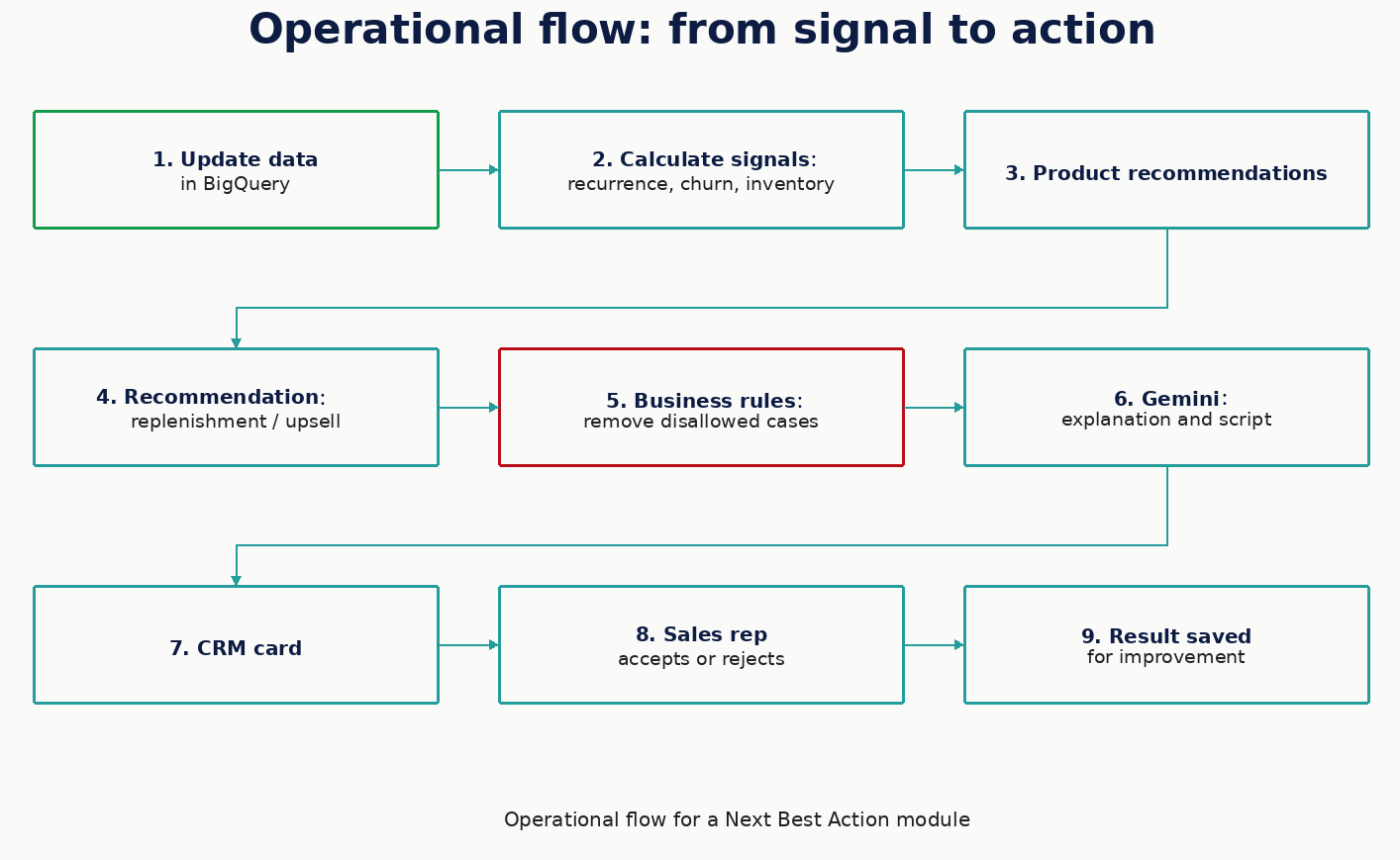
For a mature system, this flow runs daily, every few hours, or in near real-time, depending on the company's rhythm. Management and the IT department have control over it, even though it runs automatically, so they can diagnose issues at any time.
Of course, not all companies need real-time synchronization. In B2B distribution, for example, a daily batch may be sufficient. In enterprise or medical sales, where commercial cycles are long, recommendations can be generated based on events. But in principle, all actions are linked to each other in this complete flow.
Principle 3: avoid risks through planning and flow control
Here are some development risks and things to watch out for in a Next Best Action module for B2B sales.
Incomplete dataThe ERP, CRM, and stock are not synchronized. In this case, recommendations can be incorrect. |
Too many notificationsIf the system sends too many recommendations, agents will ignore it. |
Lack of business rulesWithout margin, discount, stock, and overdue rules, AI can propose risky actions for the company. |
Unclear explanationsIf the human agent does not understand the recommendation, they will not trust it. |
Lack of feedbackWithout feedback from agents, both positive and negative, the system cannot be improved because AI does not learn. Accept, reject, and reason buttons are essential. |
Conclusion: Controlled AI delivers results
Next Best Action makes sense in companies that already have commercial data but are not converting it into actions fast enough. It is especially useful if sales agents spend time searching for customer history, there are many unused cross-sell opportunities, or there are business rules that are applied inconsistently.
In these cases, a "step-by-step seller" is the optimal solution, more active than reporting software and safer than full automation (replacing people). NBA relies on the company's CRM, ERP, and procedures to increase commercial success.
Read case study: real-time reporting in Google Cloud for the gaming industry
Why OPTI?
OPTI approaches Next Best Action projects based on our experience as a Google Cloud partner for AI technologies and HubSpot CRM partner for internal workflows. Our B2B software development experience leads us to emphasize the value of procedures already existing in companies. We integrate AI into already existing workflows, without replacing the software the company runs on.
The correct AI architecture in B2B:
Commercial data ▷ AI ▷ deterministic rules ▷ CRM ▷ human feedback.
Read case study: 68% reduction in quoting time for an industrial distributor
A "step-by-step seller" system saves the time lost searching for context, provides relevant actions for the employee, and connects data from IT systems with day-to-day commercial results.
Contact us now for a free audit.