


From fast quoting to a unified view of business growth
At the end of 2025, OPTI Software launched the first version of the AI Sales platform, starting from a concrete problem in B2B distribution: sales reps spend too much time searching for dozens or hundreds of products in the ERP (with prices, stock, technical details) to build quotes. The platform delivers e-commerce working speed for the slow world of B2B sales.
Case study - AI Sales 1.0
An implementation carried out for an industrial distributor with a catalog of over 20,000 SKUs and Entersoft ERP, demonstrated without replacing the company's core systems:
- Quote preparation time dropped by 68%
- Product selection errors fell below 1%
- Average order value increased by 14%
AI Sales 2.0, available starting July 2026, is an extended platform in which the company's data about products, customers, orders, prices, and stock can be used by all its departments. The modules bring artificial intelligence into optimizing sales, purchasing, warehousing, and performance oversight by management.
The platform moves from automating the quoting process (version 1.0), to turning the company's data from all its platforms into a shared action plan (version 2.0).
Award-winning AI research program
The evolution of the AI Sales platform is tied to the results of OPTI Software's "AI Architecture for B2B 2026" research program.
In May 2026, the program won the R&D Program of the Year category at the ANIS Excellence Awards. The project's core principle is Business rules dictate, and AI executes. The proposed hybrid architecture keeps the company's exact data in deterministic databases and services. AI is used where it delivers operational advantages: fast semantic search, interpreting buyer intent, prioritizing opportunities, and conversational interaction for decisions.
The AI in B2B 2026 program includes a series of six technical guides, and the AI Sales product is the practical environment where the principles are turned into features for companies.
1. Centralized decision-making for management
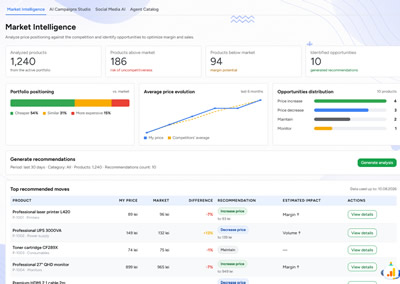
AI Sales 2.0 delivers a unified view of business performance for management. We correlate active stock, sales, orders, top customers, sales reps, and their performance together with signals and alerts that require attention. Management quickly finds out when:
- An important product is missing at several top customers
- A brand's prices have exceeded the market average
- A category has grown in isolation compared to the previous period
- The number of stockouts is trending unfavorably
- Many other correlations essential to real optimization flows
On the right side of the screen, an automatically generated summary brings together the main indicators, top customers, and commercial signals. The manager no longer needs to reconstruct the situation from multiple exports and reports.
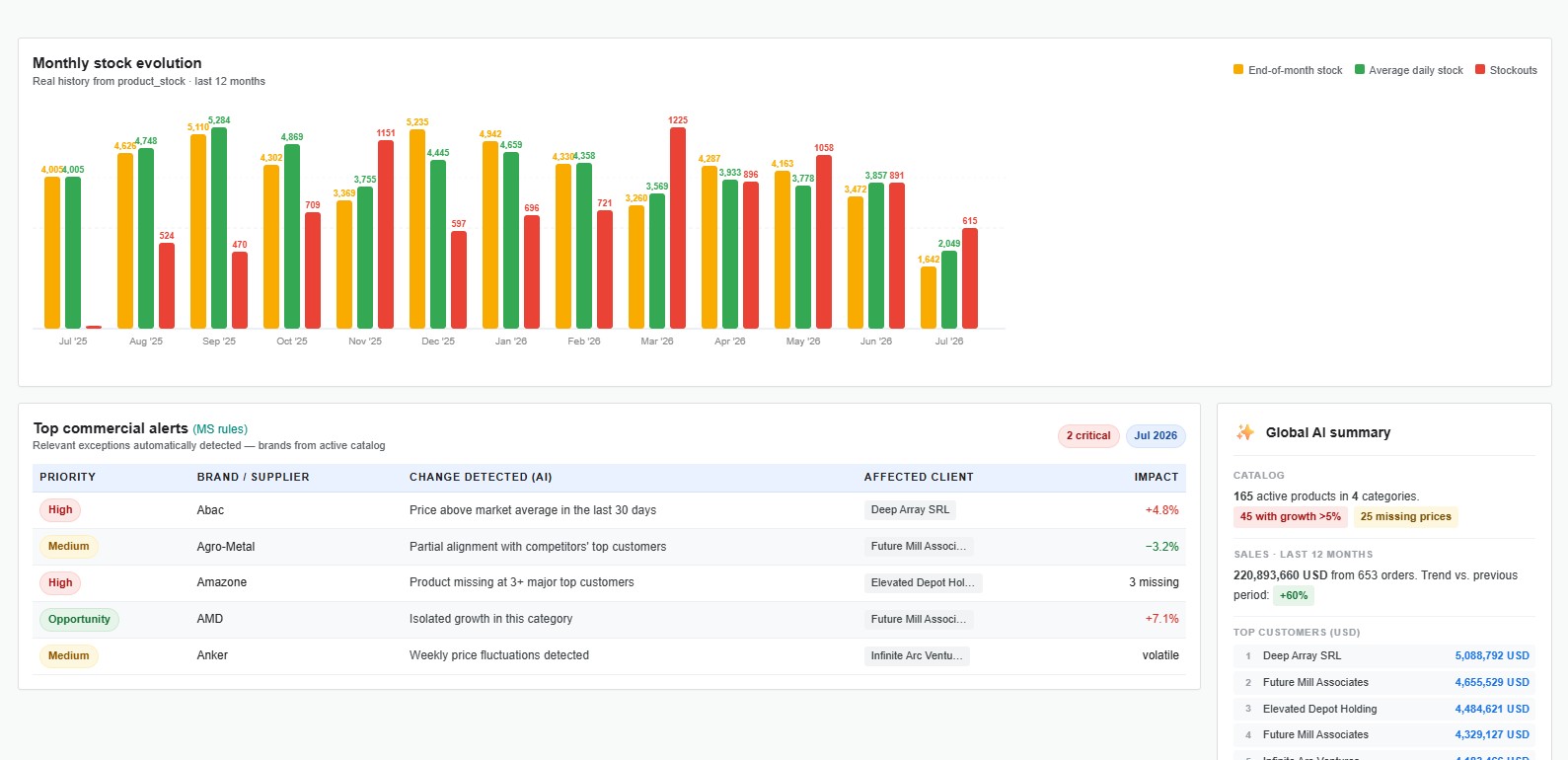
AI Sales dashboards are the place where you work daily to identify optimizations and decisions to make in the company. Unlike classic BI, where you check what happened last month.
2. Inventory predictions connected to sales and profitability
In today's competitive market, inventory management influences both the purchasing department and the company's actual sales. Out-of-stock products affect the quotes sent by reps and customer satisfaction, with direct effects on revenue and profitability. In addition, a product that no longer sells ties up capital, requiring promotional campaigns, inclusion in a bundle, or controlled stock liquidation.
The platform's AI time-series prediction module quickly delivers the necessary data:
- Products that need restocking based on estimated consumption in future periods
- Products with very slow or very fast turnover
- Products that contribute the most to profit
- Products whose stock does not cover current orders
In a real implementation, AI stock analysis can also take into account supplier lead time, stock reserved in the WMS, and other internal operating rules, for a deep integration into the company's departments.
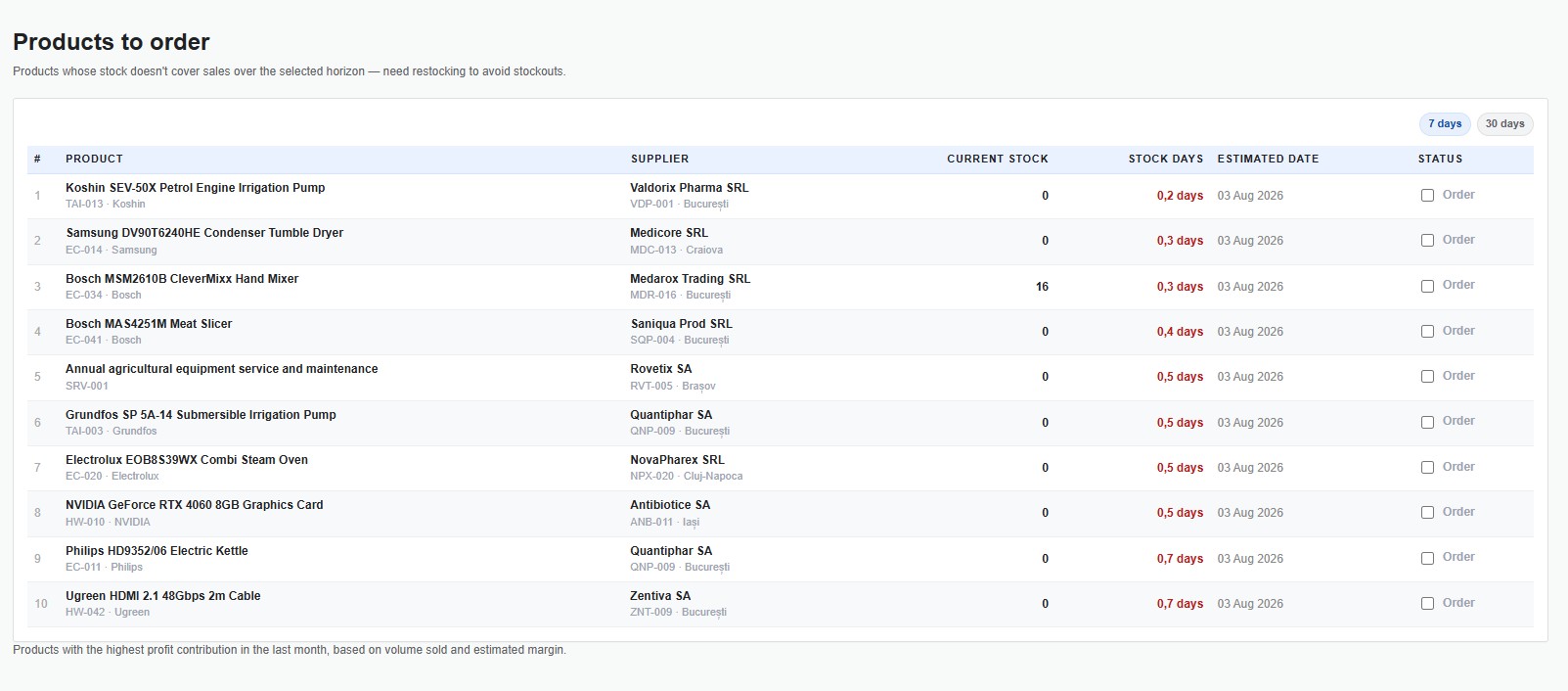
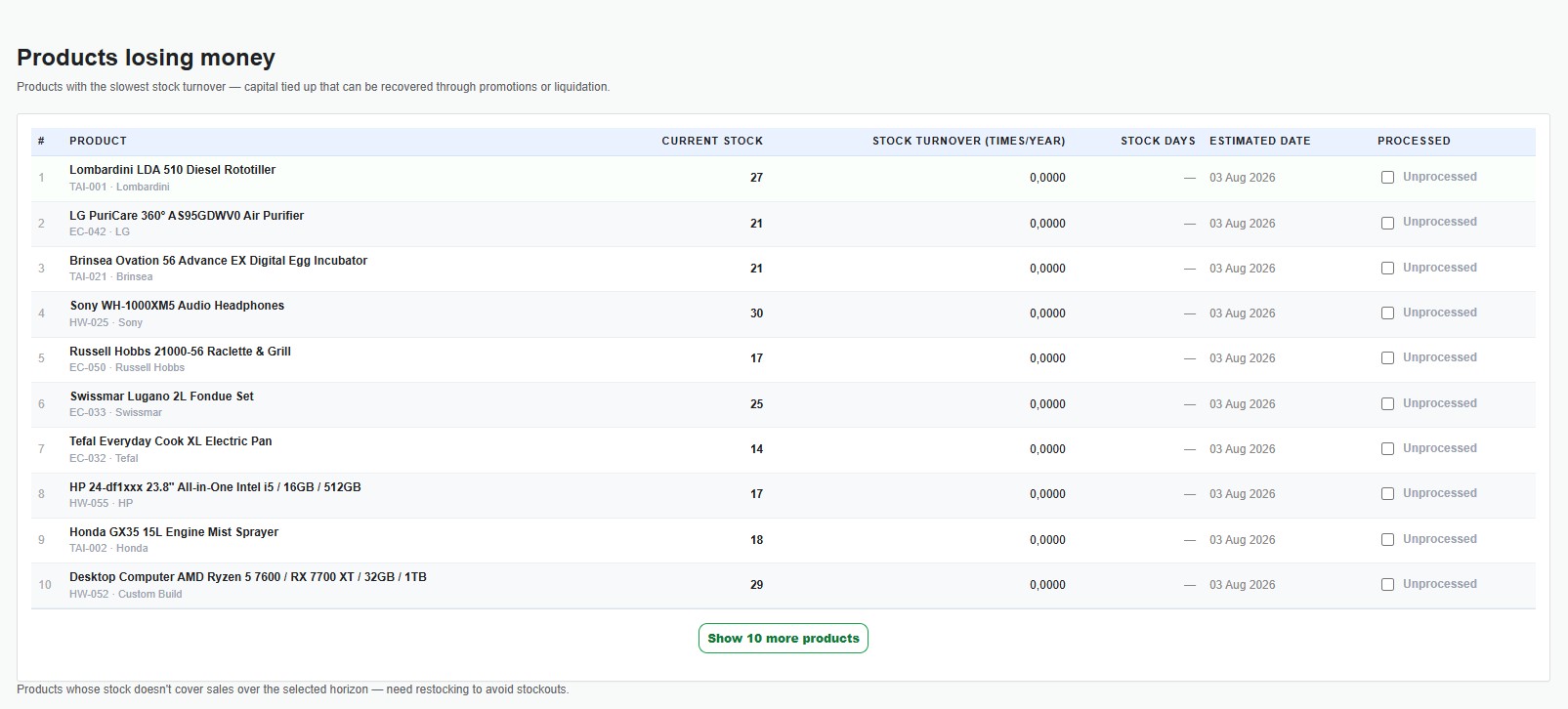
AI forecasting is valuable because the prediction can trigger an action in our platform: a restocking order, promotional actions, or aggregation of analysis with other data from the company's systems.
3. Proactive upsell and cross-sell in every quote
In AI Sales 2.0, the recommendation of complementary or compatible products can become proactive and an internal task for every sales rep.
The system identifies customers for whom commercial history indicates an opportunity, estimates the potential value, the number of relevant products, and the responsible sales rep. A manager will find out:
- Customers with the highest opportunity score
- Estimated commercial value and number of recommended products
- The rep managing that customer
- Recommendations already processed by the rep
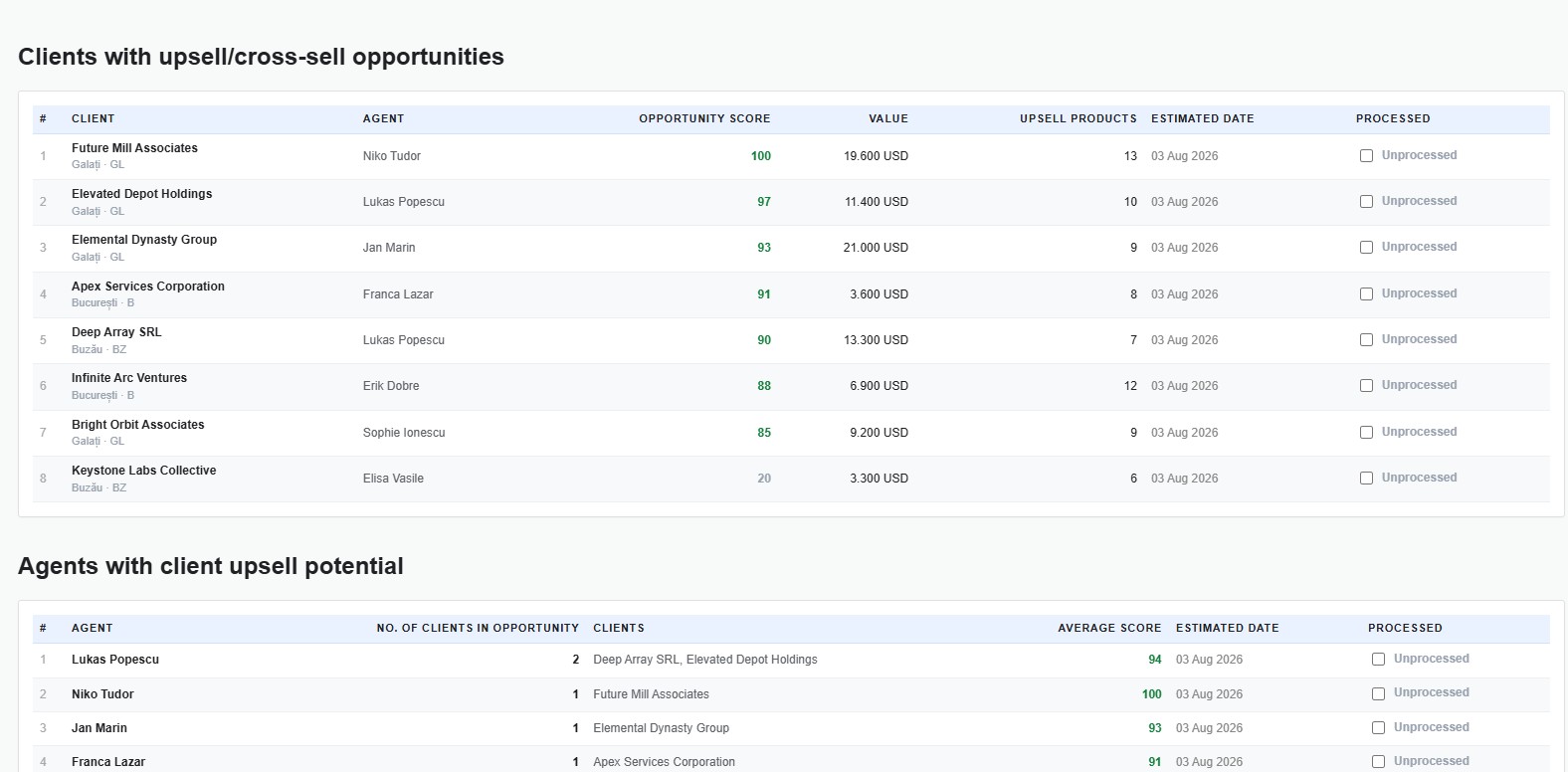
The platform anticipates the sale. The system does not wait for the rep to open an order; instead, it proposes in advance the customers worth contacting, under management's oversight.
4. Complete context for the company (per product, customer, and sales rep)
The problem the platform solves is the following. The fact that a product sold 2,000 units does not explain who bought it, at what price, through which reps, whether it was out of stock, or whether sales are concentrated in a single customer. In AI Sales 2.0, the company finds out:
- the minimum price, catalog price, and maximum selling price
- the number of orders and quotes, sales volume and value
- the evolution of sales and stock
- current stock and recommended stock
- distribution by customer and sales rep
- an AI-generated interpretation for the user
- commercial notes and actions connected to the company's systems
In the same logic, the platform includes dedicated pages for the customer and the sales rep, for jointly monitoring all aspects relevant to the business.
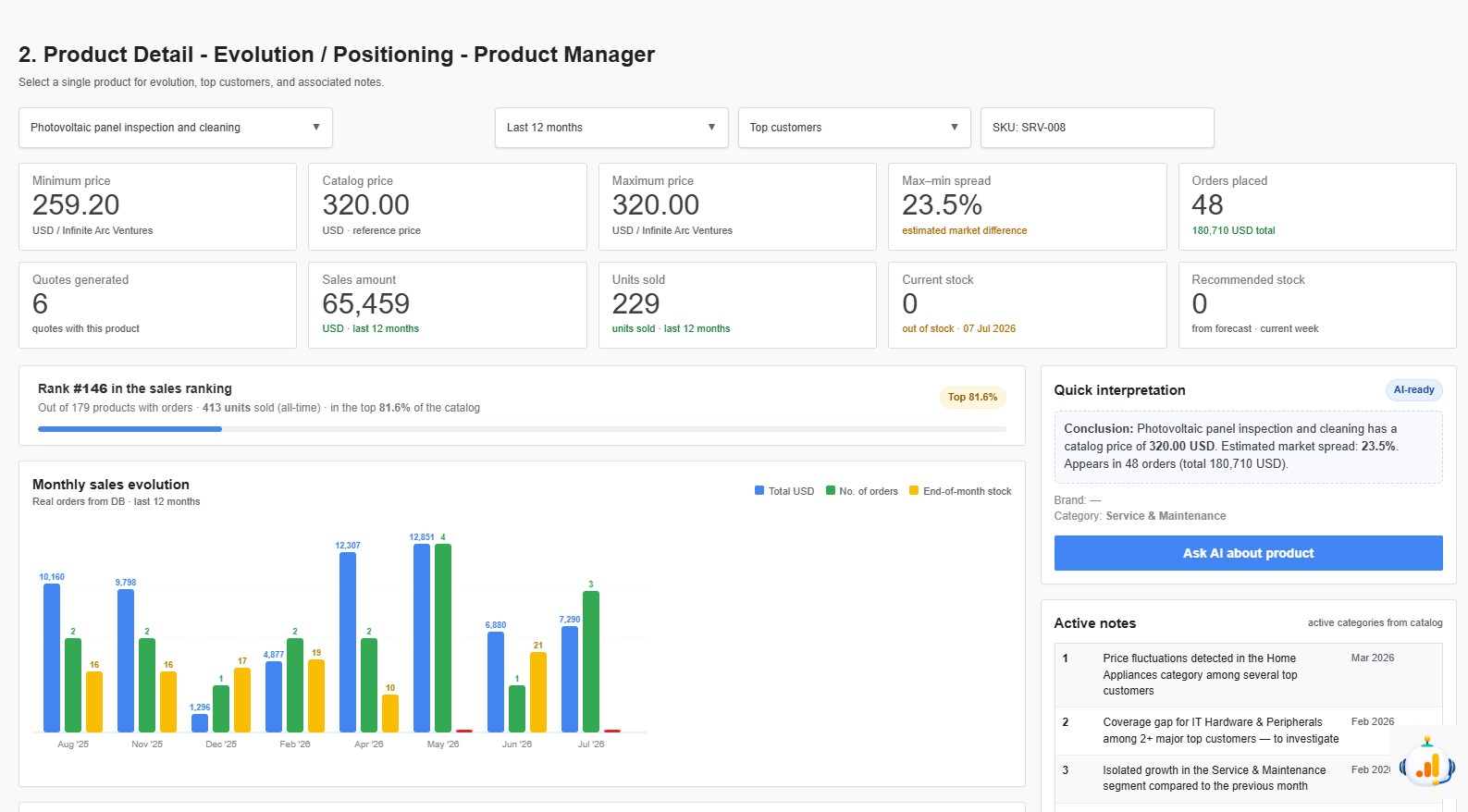
In today's competitive market, the synthetic view brought by AI Sales 2.0 is useful for the whole company: product manager, sales manager, general management, purchasing, or key account manager.
5. Conversational analysis, with tables and charts generated live from data
Fixed reports are useful when the questions are known in advance and there is a company workflow (a data engineer or a BI manager). AI Sales 2.0 provides a live answer based on advanced Google Cloud technologies (with no predefined reports) to all the questions that may come up:
- Who are the top reps in the last three months?
- Which products grew the fastest?
- Which customers have significant shortages?
- How do prices differ between two brands?
- Which category has the most stockouts?
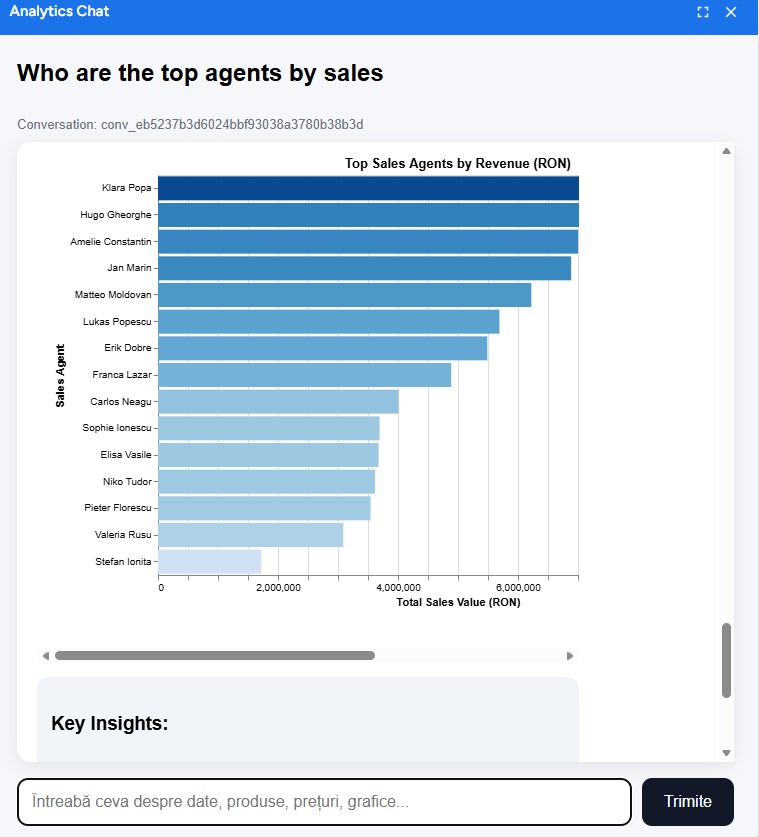
Depending on the question, the system generates tables, rankings, and charts. In addition, for enterprise implementations, access to information respects the organization's roles and permissions (for example, a rep does not have access to the entire company's financial data).
We don't replace existing systems, we make them sell more
The five features above are only part of the AI Sales 2.0 platform.
The platform's architecture creates an intelligent layer on top of ERP, CRM, e-commerce, and the company's other sources; it does not replace them and does not force a costly migration.
The advantage is the flexibility of the AI modules and features for augmenting the company's capacity. The company's data feeds a continuous process of identification, prioritization, action, and measurement, for all interested departments.
AI Sales integration diagram
ERP / CRM / e-commerce data
        │
        ▼
 AI analysis and predictions
        │
   ┌────┼──────────┐
   ▼    ▼          ▼
 Sales Purchasing Management
   │    │          │
   └────┼──────────┘
        │
        ▼
 Actions and feedback
        │
        ▼
 Continuous optimization
A platform adapted to each company's reality
In real implementations, the modules are adapted to the customer's data and details. For one company, the priority may be reducing stockouts. For another, it may be discount control, increasing average order value, or identifying customers who no longer buy an important category.
AI Sales 2.0 is the intelligent extension that makes the company's data more accessible and more useful for profitability. Companies interested in a pilot of the platform identify, together with OPTI consultants, a limited and measurable fundamental problem:
- Reducing quoting time
- Identifying products at risk of stockout
- Prioritizing upsell opportunities
- Controlling prices and discounts
- Analyzing commercial performance through questions asked in natural language
The result of the integration is measured through improved business indicators. The philosophy of the AI Sales 2.0 platform is that AI that is useful for business starts with correct data, clear rules, and management decisions that can be improved.
Want to test AI Sales 2.0 on a real process? We can analyze your existing data and workflows and define a pilot project with measurable objectives, without replacing your current ERP or CRM.
Note: All screenshots come from the AI Sales 2.0 demo platform and use exclusively fictional data.