


Updated October 2, 2026: recap and post-event notes.
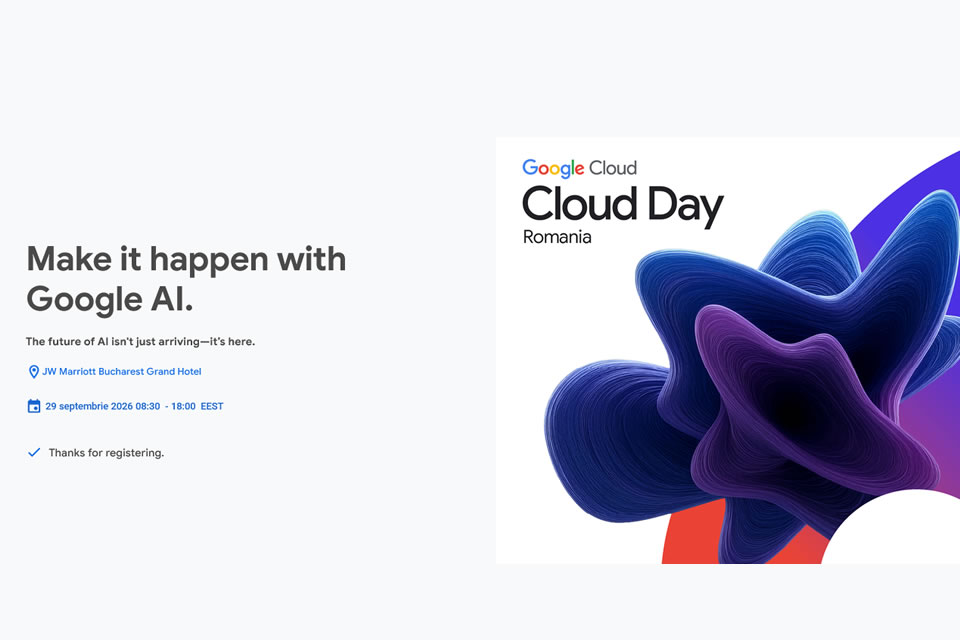
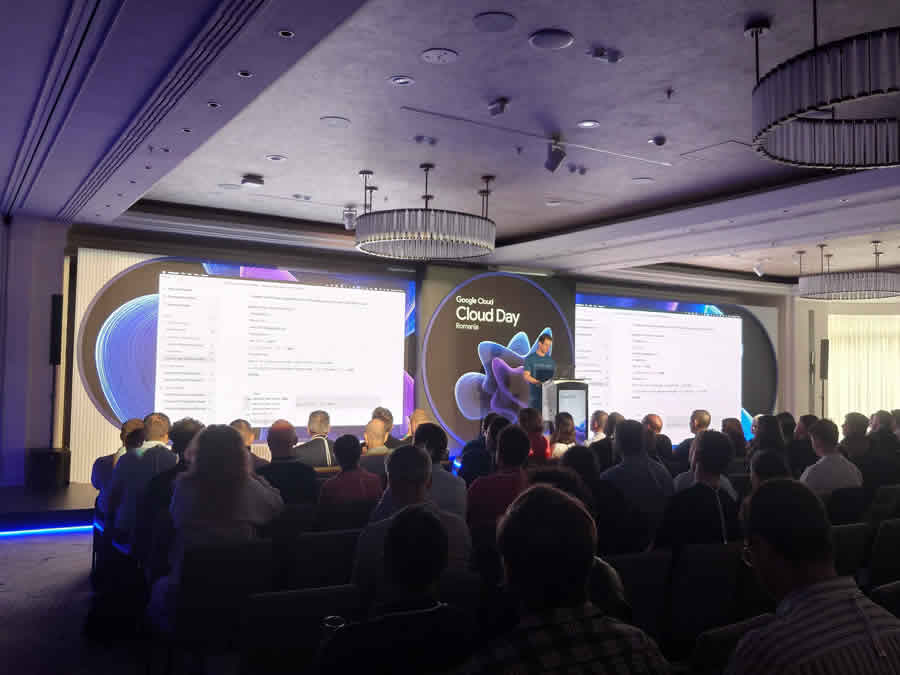
Google Cloud Day Romania 2026 took place on September 29 in Bucharest, with the official theme "Make it Happen with Google AI." This year, our team followed the event together, splitting up to attend various technical sessions. There were sessions so novel and relevant to the Agentic AI era that they were well worth noting down. (Photo source: Official Google website).
For those interested in the previous edition, we documented how in 2025 we moved from hype to the AI implementation stage.
Highlights of the 2026 edition
Antigravity: the most interesting part isn't just that it writes code
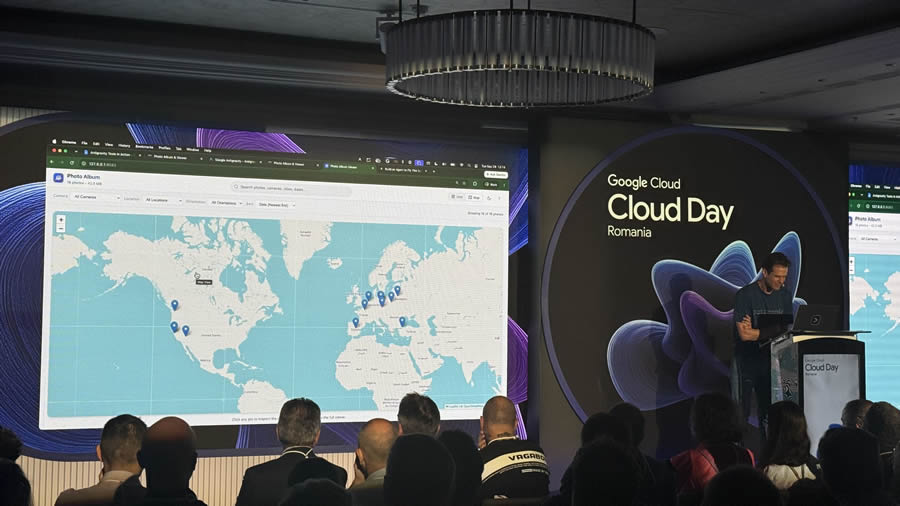
The Google Antigravity demo was a standout for all our colleagues. The agent built and modified a web application live, but the most interesting aspect was how it handled situations where the requirement wasn't entirely clear.
Instead of guessing what you wanted, it could ask questions and build the specifications collaboratively. The demo involved creating a photo gallery, a map, and image analysis functions; the AI agent then navigated the application to automatically verify the features.
Google has also recently introduced the /plan mode: the agent can analyze the project, clarify requirements, and propose a plan before modifying the code. It’s about interactivity, not just "AI writing an application."
GKE Pod Snapshots: no more starting from scratch every time
A very recent technical update came from the session titled Next-Gen GKE: Deploying Smarter, Scaling Faster, Managing Simpler. The issue is straightforward: a Pod can waste minutes loading files, dependencies, and model weights before it is ready to work.
With GKE Pod Snapshots, the already initialized state is saved and restored—including CPU and GPU memory. Google reports startup time reductions of up to 89%: in published tests, a 70B-parameter model started in 37 seconds, while an 8B model took 15 seconds. (Source)
In short: instead of the boot-download-load-initialize sequence — with time consumed at each stage — a workload will resume directly from a functional state. For applications with heavy initialization requirements, the difference will be noticeable in production.
An agent that opens the locker
Another demo showcases AI integration in a mechanical context: a customer cannot pick up their package because the locker code has stopped working.
The customer calls, the AI agent takes over the conversation, requests the necessary details, identifies the person, the order, and the specific locker, and proceeds to execute the action that allows the customer to pick up their package, having the required permissions.
The immediate question that arises here is: how do you prevent such a workflow from being abused? The demo did not delve deeply enough into the security aspect for us to answer that. However, the difference compared to standard chatbots will matter in real-world scenarios: the AI agent is granted the authority to mechanically influence a real-world system.
Other sessions at Marriott
Google Workspace. One of the presentations showcased AI agents for presentations, documents, and natural language searches for company information. The session presented an estimate of 150–200 hours saved annually per employee for specific types of searches.
Recommendation systems. The session on meal recommendations closely resembled the B2B projects OPTI carries out, even though the presentation remained general in nature—partly due to NDA constraints. From public materials released by OChK, we know the solution utilizes a Two-Tower model and has achieved twice the accuracy in predicting user choices, while also reducing the time required to make a selection.
DIY AI. There was also a track dedicated to self-hosting open-source models using Cloud Storage, BigQuery, and GKE. In an agenda dominated by Gemini, it is worth noting that for some organizations, self-hosted models and infrastructure control remain a realistic option.
What we were looking out for before the event
We have retained below the three themes identified from the pre-event agenda as a reference for the 2026 edition. The program can be grouped into three cross-cutting categories.
AI connected to real data and business processes
Applying Google Cloud in real-world contexts, including banking, analytics, and marketing, in sessions such as:
- "Building the Smart Enterprise with Gemini Enterprise Application"
- "Databases - How BigTable Powers Modern Banking"
- "CLI to Production: Accelerating Enterprise Agent Deployment with Gemini Enterprise Agent Platform"
- "Conversational Analytics in BigQuery with marketing data sets"
Why does it matter? In 2026, the challenge is connecting AI to real data: transactions, customers, or products. BigQuery and Google Cloud databases are becoming part of the architecture of AI applications.
Secure Production Architectures in the AI Era
Enterprise security patterns, secure digital workplace, agentic threat mitigation, in sessions such as:
- "Trust in the Age of Agents: Enterprise Security for AI Platforms"
- "Codemender in Action: Self-Defending Code & Agentic Threat Mitigation"
- "Sovereignty by Choice: The Schwarz Group's Blueprint for a Secure Digital Workplace"
Why does it matter? The fact that the agenda brings together enterprise security, agents, and even self-defending code is a sign of technology maturing: security is treated at the architecture level, not added at the end.
Modernizing Applications and Operation
Probably be the theme with the widest applicability: how to add AI to an existing application and control AI software development. Announced sessions :
- "Build custom agents powered by the Antigravity harness Hands-On"
- "Predicting Your Favorite Meals: Implementing Recommendation Systems in Diet Catering"
- "Conversational Genius: Elevating Customer Experiences with AI"
Why does it matter? Most companies' question is "Where and why is it worth adding AI on top of the software we already use?"
Taken together, the three themes describe fairly well the shift in AI projects over the past year: the necessary alignment to an enterprise architecture where you build in order data & context > security & control > application & operation.
See our article from June about Agentic AI differentiators in Google Cloud
Note: The full program is available here
Participants
In addition to Boris Georgiev, Director of Google Cloud CEE & Central Asia, Google leaders Carolin Eggers (AI & Data Analytics EMEA), Mariya Andonova (Workspace CEE), Dmitriy Novakovskiy (Principal Architect CEE) and Dana Baranes-O'Hara (Startup Business Lead CEE) were present.
Contributions from the ecosystem:
- Orange (Bogdan Hovanet): Orange & Google Cloud Platform: A Data Migration Story
- Oracle (Cristian Necula): Better Together: The Best of Oracle and Google Cloud on One Stage
- Wise IT (Sorin Tonciu) & Help Autism Association (Ionut Cocias): Building AI Agents with Gemini Enterprise to Create Your Autonomous Business Assistant
- JetBrains (Nik Tkachev): Why coding agents fail to boost productivity
- Zitec (Radu Sandulescu): Data Quality by Design: Catching Issues Before They Impact the Business
OPTI at Google Cloud Day
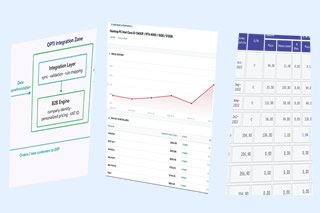
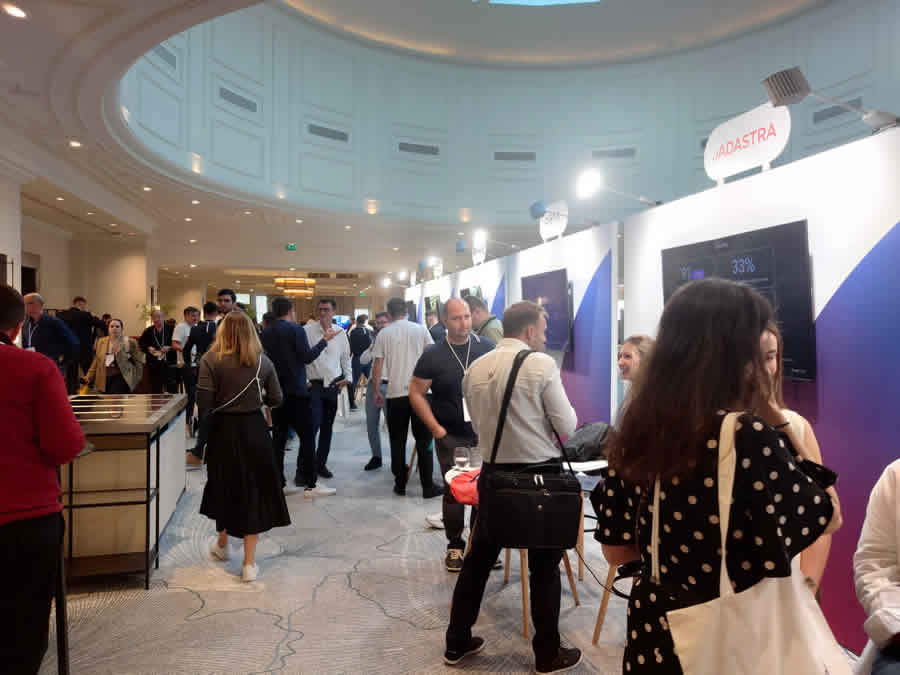
Our colleagues attended Google Cloud Day. As a Google Cloud implementer, we also work on integrating an AI layer over ERPs, CRMs, and other data, without rebuilding them from scratch. We documented this approach in the "AI B2B Architecture" series, awarded by ANIS in 2026, and we use it in the AI Sales 2.0 platform.
Attended the event and want to talk? Contact us or write to us on LinkedIn.
Google Cloud Day Romania 2026 Details
Date: September 29, 2026
Location: JW Marriott Bucharest Grand Hotel
Address: Calea 13 Septembrie 90, Bucharest
Event hours: approximately 08:30 AM–06:00 PM
Parking: available (paid)
Official info: Official Google page →