Brief of September 2026
Agent costs, 3 integrations, Google Cloud Day and How to Web
In newsletter: Concrete AI numbers, projects, and updates.
See September Brief

Three Romanian companies in manufacturing and distribution used the SocrateCloud and Pluriva ERP systems to manage customers, products, inventory, pricing, and commercial rules. Their websites were built in WordPress, while expanding the digital sales channel required a B2B portal connected directly to the ERP.
A B2B store could not operate with the same pricing and commercial terms for every user. Each customer company had to be correctly identified and matched with the commercial conditions defined in the ERP - on product pages, in search results, in recommended-product sections, when selecting product variations and, finally, when placing an order.
OPTI designed and implemented an integration layer between the ERP and WooCommerce, allowing the ERP to remain the source of commercial rules while the website became a self-service portal for business customers.
The objective was to keep the ERP as the single source of truth while providing a simple and fast ordering experience for B2B customers.

The B2B eCommerce portal had to preserve the ERP's commercial logic at every stage of the online customer experience.

OPTI implemented custom B2B WooCommerce extensions and an integration layer adapted to each client's ERP environment.
The solution separated three essential responsibilities: company identity, commercial rules, and data synchronization.
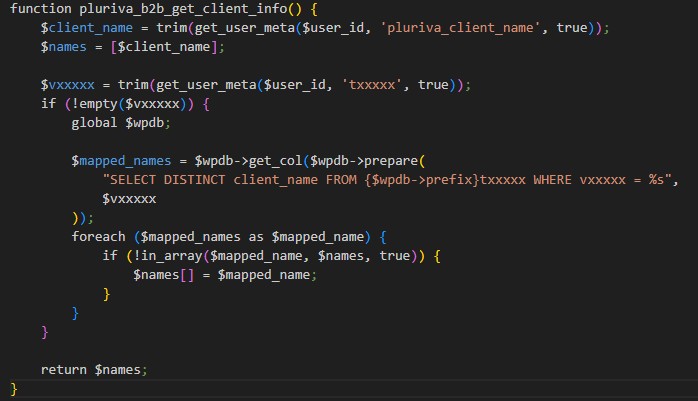
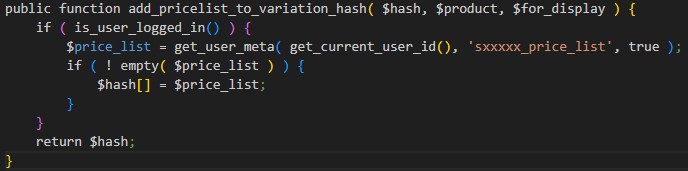
The integration built by OPTI keeps commercial data in the systems where it is already managed and exposes to WooCommerce only the information required for the B2B purchasing experience.
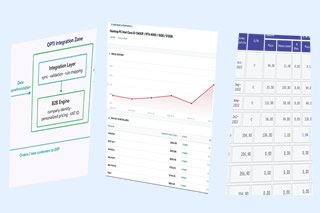
The ERP remains the source of truth for customers, prices, products, and stock, while the integration layer translates that data to WooCommerce and synchronizes it back to the ERP whenever customers order or register online.
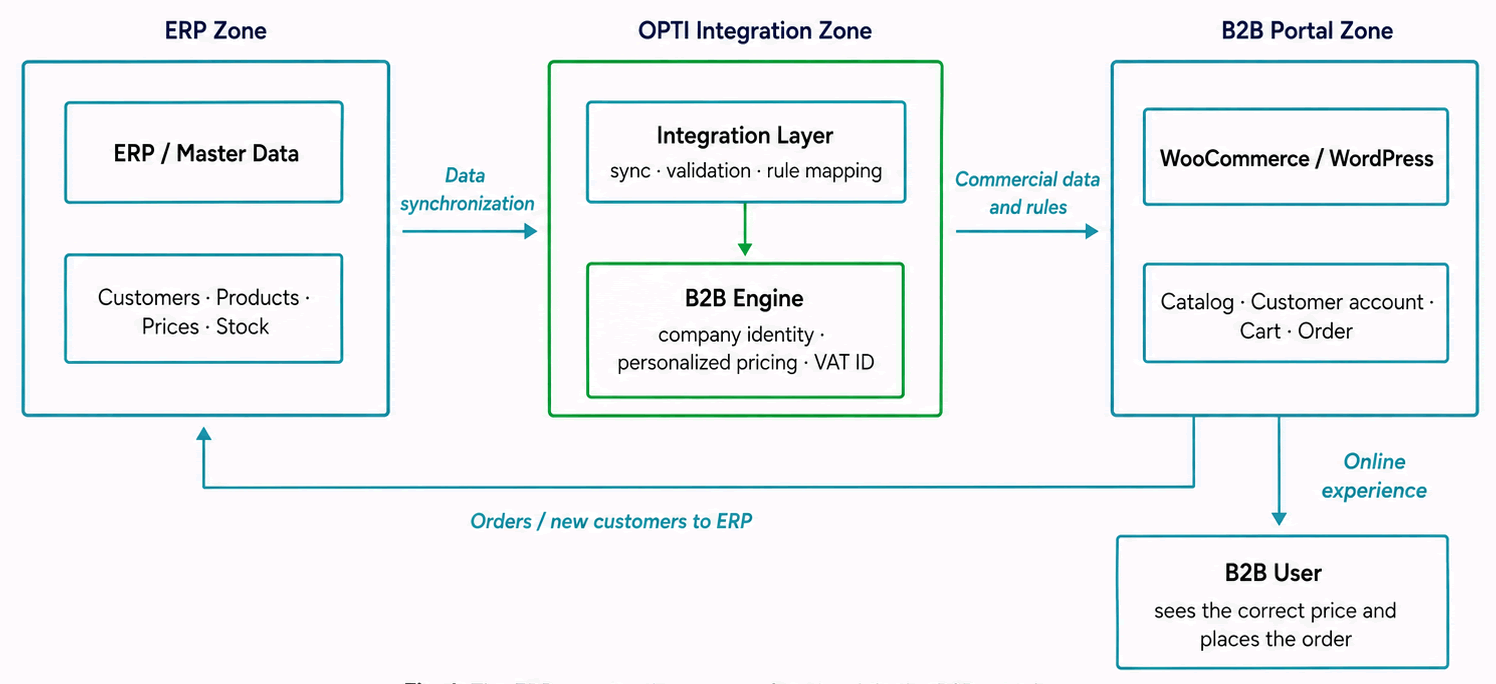
A similar B2B portal, integrated with your ERP, can be delivered in a few months of work. Let's talk.

It is an online store (WooCommerce) that displays pricing, stock, and commercial rules identical to those in the ERP, for every authenticated business customer.
Each customer company has its own negotiated price list and discounts in the ERP, which must be reflected identically in the store, on product pages, search, recommendations, and checkout.
The system groups records by VAT ID and treats all related identities as part of the same commercial entity, applying the same special pricing.
A customer marked as eligible in the ERP automatically receives an account on the website, and a new company registered on the website is automatically created in the ERP, with real-time VAT ID validation.
No. The ERP remained the source of truth for pricing, stock, and commercial rules; WooCommerce became only the self-service interface for customers.
Over 5,000 B2B customers synchronized and over 1,000 B2B orders per month, with a launch free of downtime and no impact on existing B2C orders.
This case study shows that a B2B portal only works correctly when the ERP remains the single source of truth for pricing, stock, and commercial rules, while WooCommerce becomes a synchronized self-service interface rather than a parallel data system.
Technologies: WordPress, WooCommerce, PHP, MySQL, SocrateCloud, Pluriva, REST API, cron, National Bank of Romania exchange rate
Methodologies: Business analysis, ERP-eCommerce integration, WooCommerce extension development, data synchronization, regression testing, controlled rollout

Articol scris de
Data Engineer (Google Cloud Certified Professional). CRM Automation, AI, mobile.
Vezi profil LinkedIn →