INTRO

FROM THE TICKETING PLATFORM TO THE 360° FAN PROFILE

For a sports club, every ticket purchase provides information about the chosen game, ticket type, attendance, and the history of interactions with its fans.

The vivenu platform managed events, tickets, and transactions, HubSpot managed contacts and communication, while the internal systems of a professional basketball club in Israel required consolidated information about buyers and spectators.

In 2025, OPTI imported the data from vivenu into HubSpot through custom objects and custom associations. In 2026, the integration was extended to synchronize the consolidated data from HubSpot to the club's other systems.

Why OPTI: the project combined two essential competencies - custom systems integration and advanced data modeling in HubSpot. Under the coordination of Glare Marketing, the OPTI team used custom objects, external identifiers, custom associations, and batch operations to accurately reflect the relationships between fans, tickets, games, and the hundreds of thousands of tickets managed.


HubSpot
vivenu
HubSpot integration for sports ticketing - vivenu and a professional basketball club

CHALLENGES

The data from vivenu had to be accurate, connected, and easy to use in HubSpot, for a club with hundreds of thousands of tickets sold.

  1. Fragmented data and incomplete profiles
    • A HubSpot contact had no information about their tickets and game attendance, while all this data already existed in vivenu. The goal was to unify the information into a single system.
  2. The standard HubSpot data model was not enough
    • The standard objects in HubSpot could not simply represent the specifics of ticketing data. A "ticket" was not a support ticket, but a game ticket, with a different structure.
  3. Relationships were just as important as the data
    • A ticket had to be linked to the buyer, attendee, game, and transaction, providing full context for each ticket, usable by management, and ready for AI agents.
  4. Repeated updates, without duplicates
    • The system had to recognize existing data and decide whether to update it or create new records, via an upsert logic.
Daniel Curculescu
"A large import into HubSpot is relatively simple. The difficult part is idempotency: to be able to resume synchronization without duplicates and without losing the relationships between objects. That is why we used external identifiers, batch upsert, and association labels. And custom objects for the specific data logic."
Daniel Curculescu, Software Engineer

SOLUTION

OPTI built the integration in two stages:

Phase 1: importing data from vivenu into HubSpot.

Phase 2: synchronizing the consolidated data from HubSpot to the club's internal systems.
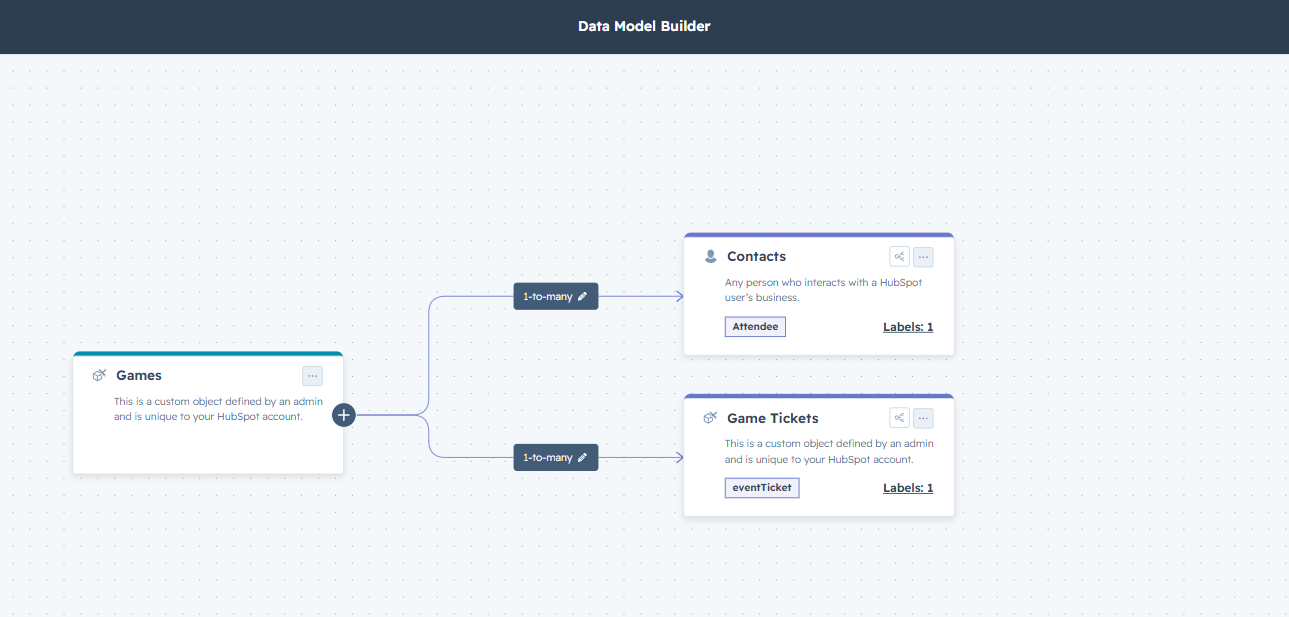
  1. HubSpot data model for sports and ticketing

    • A model was built around the following entities:
    • Games: games and sports events
    • Game Tickets: individual tickets
    • Contacts: buyers and spectators
    • Deals: associated transactions
    • Activities: emails, calls, meetings, notes
    HubSpot data model: Games connected with Contacts and Game Tickets
    HubSpot data model: connecting Games with Contacts and Game Tickets reflects the relationship between a game, spectators, and issued tickets.
  2. Import vivenu > HubSpot

    • Data about games, tickets, buyers, and transactions is extracted from vivenu, normalized, and mapped to the corresponding HubSpot objects. The integration creates new records or updates existing ones.
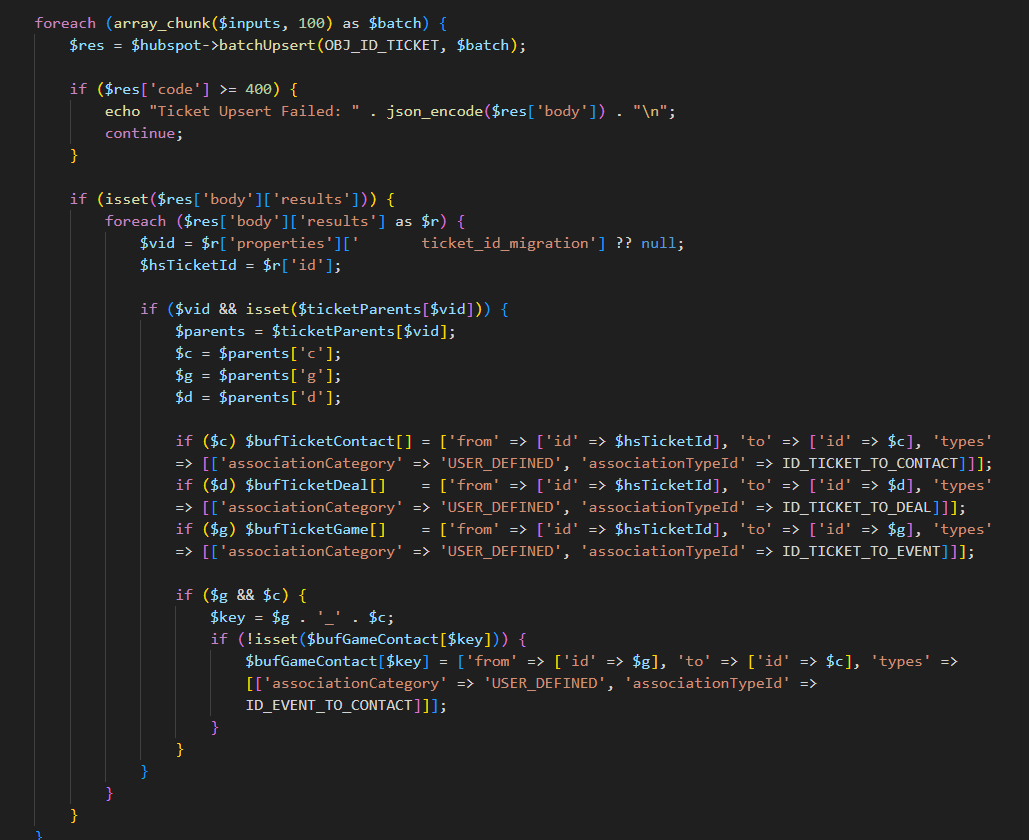
    API integration: vivenu - HubSpot batch upsert logic
    API integration: the batch upsert logic creates or updates HubSpot objects and generates the associations between tickets, contacts, deals, and games.
  3. Custom associations for real context

    • The integration programmatically creates the relationships between objects:
    Games > Contacts Game Tickets > Deals
    Games > Game Tickets Game Tickets > Games
    Game Tickets > Contacts Game Tickets > Activities
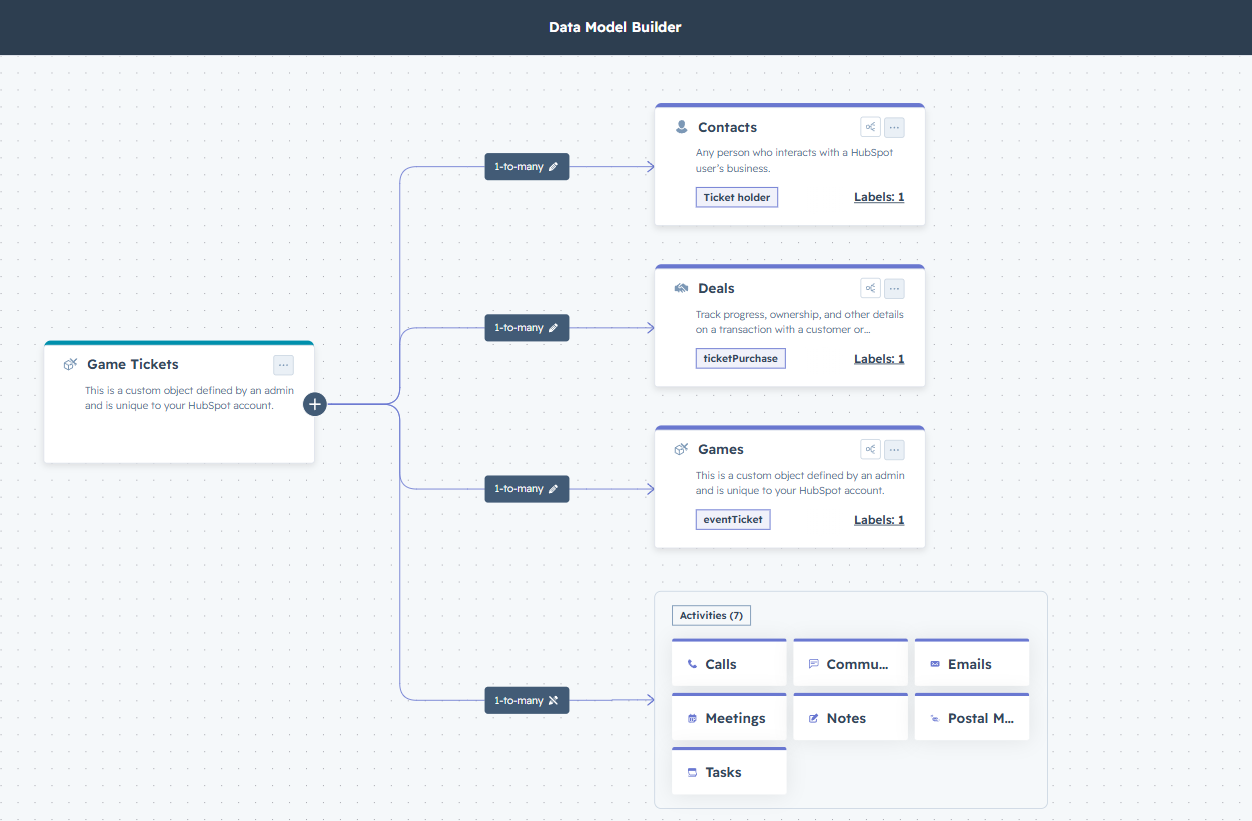
    Extended data model: Game Tickets connected to Contacts, Deals, Games, and Activities
    Extended data model: connecting Game Tickets to Contacts, Deals, Games, and Activities.
  4. HubSpot synchronization to the club's systems

    • In the second stage, HubSpot also becomes a data source for the club's other applications, through new integrations. Consolidated information about users, tickets, and attendance now comes from HubSpot, without any system needing to connect separately to the ticketing platform.

This case study shows that a CRM can become a true sports customer data hub when data modeling and custom associations accurately reflect the real relationships between fans, tickets, and games, providing full context for every ticket managed.

ARCHITECTURE

The integration is organized around HubSpot, which becomes a customer data hub. vivenu remains the source for ticketing, and the component built by OPTI manages the transformation, validation, and synchronization of data with other systems.

Phase 1: vivenu > Integration Layer > HubSpot > Business team
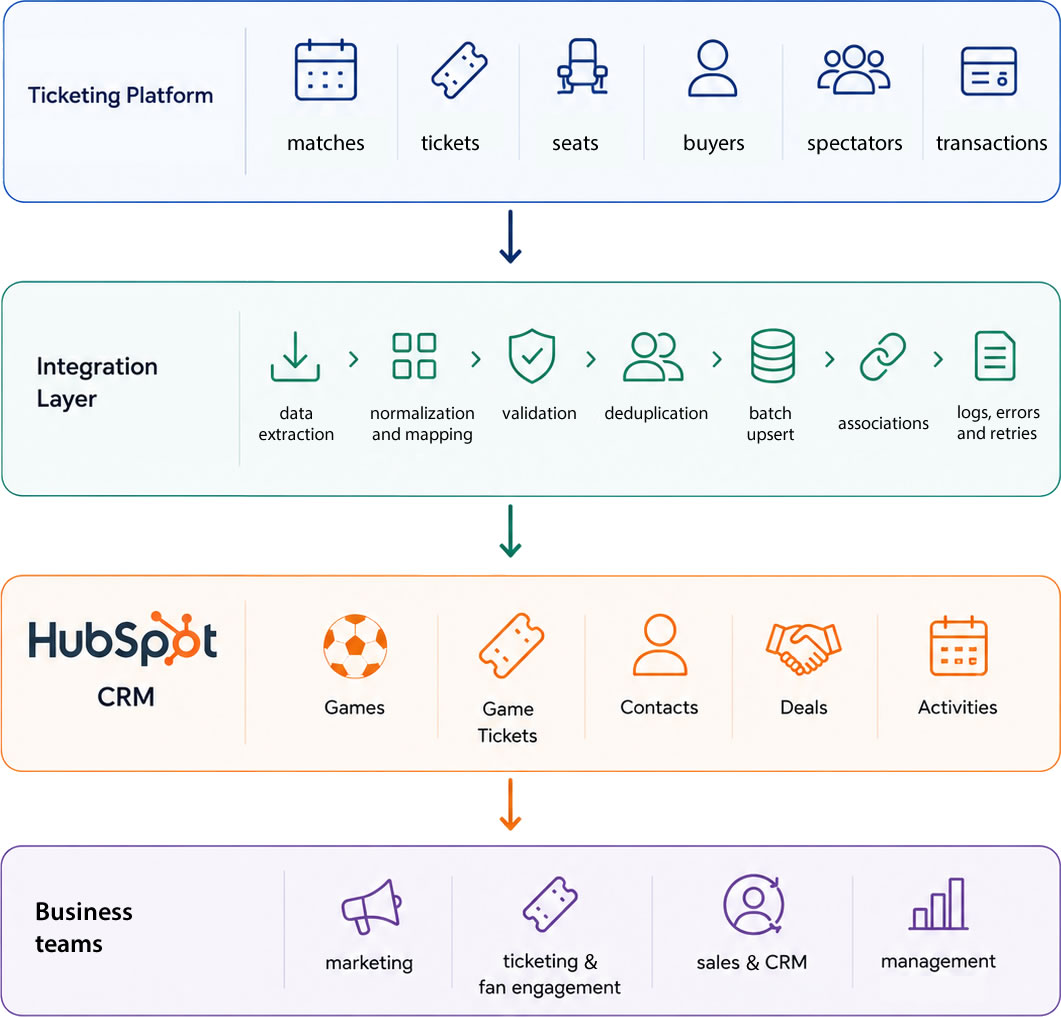
vivenu to HubSpot integration architecture - Phase 1
Data flow from vivenu, through the integration layer, to HubSpot and the business team.


Phase 2: HubSpot > Integration Layer > other club systems.

RESULTS

TWO STAGES, IN 3 MONTHS OF WORK

Customer data hub for the club

HubSpot became a customer data hub. Contacts, tickets, games, and transactions are available in a single CRM.

100k+ Game Tickets visible in HubSpot

Each Game Ticket is associated with a contact, a deal, and a game, providing context for the records.

360° view of fans

The team can see the history of tickets and attendance, alongside other contact data.

100+ games connected with spectators

For each event, issued tickets, associated contacts, and attendees can be tracked.

Foundation for relevant segmentation

Data can be used for groups such as attendees of a specific game, returning buyers, or ticket holders.

Millions of relationships, 0 sync duplicates

Automated imports and associations reduce Excel exports, repetitive checks, and manual updates.


Interested?

A similar HubSpot integration can be delivered in a few months of work. Let's talk.

TECHNOLOGIES AND METHODOLOGY

  • Services: HubSpot integration, CRM data modeling, custom objects configuration, properties, association labels, API development, incremental import, batch upsert, deduplication, reverse synchronization, and QA.
  • Tech: HubSpot CRM API, Custom Objects API, Associations API, Batch API, vivenu API, PHP, JSON, REST APIs.
  • Methodologies: Discovery & data mapping, data modeling, error handling and retry, reverse sync preparation.
  • Standards: ISO 9001 (quality), ISO 27001 (information security).

References

Quick Questions

What is a sports customer data hub?

It is a HubSpot CRM extended with custom objects (Games, Game Tickets) that centralizes data about games, tickets, buyers, and attendance coming from a ticketing platform such as vivenu.

Why weren't HubSpot's standard objects enough?

A game ticket doesn't behave like a standard support ticket - it has a different structure and different relationships, which is why custom objects (Games, Game Tickets) and custom associations were created.

How were duplicates avoided on repeated syncs?

Through external identifiers and batch upsert operations: the system recognizes existing records and updates them instead of creating duplicates.

What data was connected in HubSpot?

Games, individual tickets (Game Tickets), buyers and spectators (Contacts), transactions (Deals), and activities such as emails or calls.

Was the vivenu ticketing platform replaced?

No. vivenu remained the source for ticketing, while HubSpot became the customer data hub, with a custom component managing data transformation and synchronization.

What measurable results were achieved?

Over 100,000 Game Tickets visible in HubSpot, 100+ games connected with spectators, and 0 sync duplicates, in just 3 months of work.

What will be synchronized in the project's second stage?

Consolidated data from HubSpot will be synchronized to the club's other internal systems, with HubSpot becoming a data source for future integrations.

What is the TLDR (conclusion)?

This case study shows that a CRM can become a true sports customer data hub when data modeling and custom associations accurately reflect the real relationships between fans, tickets, and games, providing full context for every ticket managed.

What technologies and methodologies are involved?

Technologies: HubSpot CRM, HubSpot Custom Objects API, HubSpot Associations API, HubSpot Batch API, vivenu, vivenu API, PHP, REST API, JSON
Methodologies: CRM data modeling, custom API integration, batch upsert, custom associations, incremental import, reverse synchronization, QA and testing

Daniel Curculescu

Article written by

Daniel Curculescu

Data Engineer (Google Cloud Certified Professional). CRM Automation, AI, mobile.

See on LinkedIn →

Read more

Interested?

Interested?

Let's talk

Similar stories


Case Study: Implementing schema.org / JSON-LD for GEO (AI Search) in B2B and eCommerce
31.03.2026
Case Study: Implementing schema.org / JSON-LD for GEO (AI Search) in B2B and eCommerce
Case Study: How we built reusable semantic graphs for three websites (B2B and e-commerce) using server-side schema.org / JSON-LD, achieving more stable indexing, ~70% GSC click growth, and the first AI Overviews.
Case Study: Financial Sentiment Analysis with GenAI & Google Cloud
25.09.2025
Case Study: Financial Sentiment Analysis with GenAI & Google Cloud
Case Study: How we transformed 4 years of dense financial reports into a daily sentiment score which is generated in 4 minutes using Google Gemini and Vertex AI.
Case Study: Mobile Micropayments Platform for Gaming
28.03.2023
Case Study: Mobile Micropayments Platform for Gaming
Case Study: How we developed a scalable platform for Playwing that handles billions of mobile micropayments globally by integrating hundreds of payment systems.

News and Guides

More News