


AI Sales 2.0 by OPTI adds a layer of data, automations, and AI agents on top of existing systems for efficient commercial processes.
On-prem ERP companies usually don't lack data. The problem is that the company's data is fragmented across the ERP and other systems: CRM, website, Excel, WMS, or other applications.
Fragmentation creates a gap between what the company has and what it can do right away:
- Does the sales team see when an important customer starts buying less?
- Does purchasing see if there's more than a month of stock?
- Does the pricing team see the product's positioning against competitors?
- Does management see which AI agents are running, what they generated, and how much they cost?
What does the AI Sales 2.0 platform from OPTI bring?
- Multiple specialized AI agents working together toward the same business goal
- Building automations with AI elements for reducing costs
- Unifying access to relevant data for reporting and action
1. How Does AI Sales 2.0 Solve Data Fragmentation?
A company may have prices and orders in the ERP, the commercial relationship in the CRM, certain reference lists in Excel, and stock in a WMS. If each AI agent is connected separately to each source, the number of integration points grows and the solution becomes harder to manage.
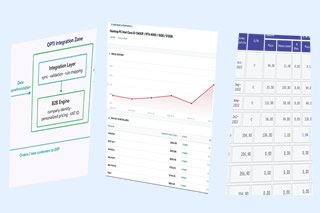
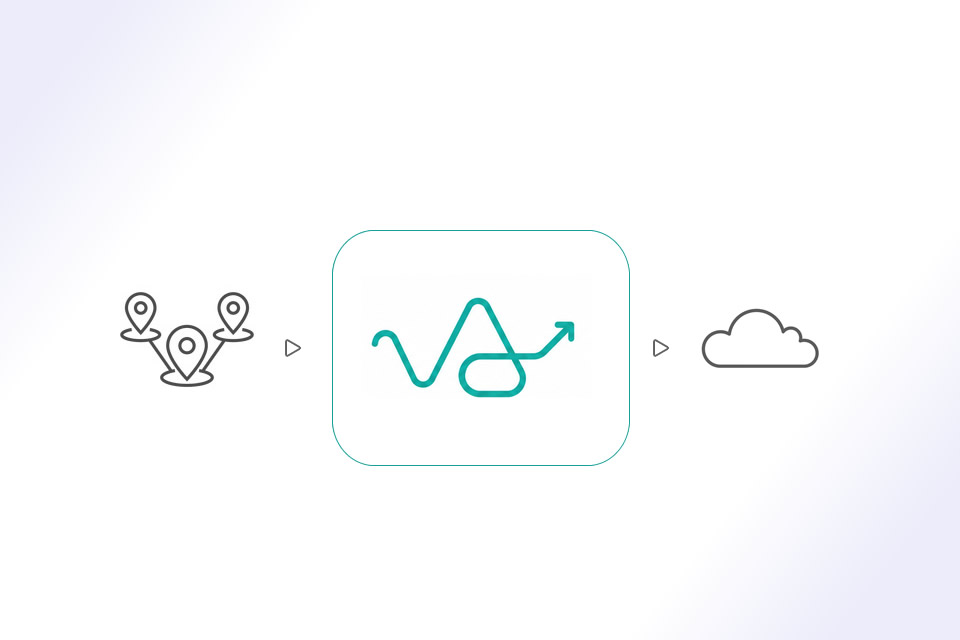
That's why AI Sales 2.0 is the shared intelligence and data layer between systems. OPTI handles synchronization and the controlled exposure of the necessary data, with security mechanisms and controlled access.
What does the shared intelligence and data layer look like?
THE COMPANY'S EXISTING SOURCES

┌─────────┐  ┌─────────┐  ┌─────────┐  ┌─────────┐
│   ERP   │  │   CRM   │  │   WMS   │  │ Excel / │
│         │  │         │  │         │  │  files  │
└────┬────┘  └────┬────┘  └────┬────┘  └────┬────┘
     │            │            │            │
     └────────────┴─────┬──────┴────────────┘
                         │
                         ▼
┌────────────────────────────────────────────────┐
│                 AI SALES 2.0                    │
└───────────────────────┬──────────────────────────┘
                         │
          ┌──────────────┼──────────────────┐
          │               │                  │
          ▼               ▼                  ▼
    Automations      AI agents        Smart applications
The ERP doesn't disappear; it still remains the source of truth for the things it was built for: invoices, stock, and accounting entries. AI Sales 2.0 adds visualization and smart actions.
2. Sales: Which Customers Started Buying Less?
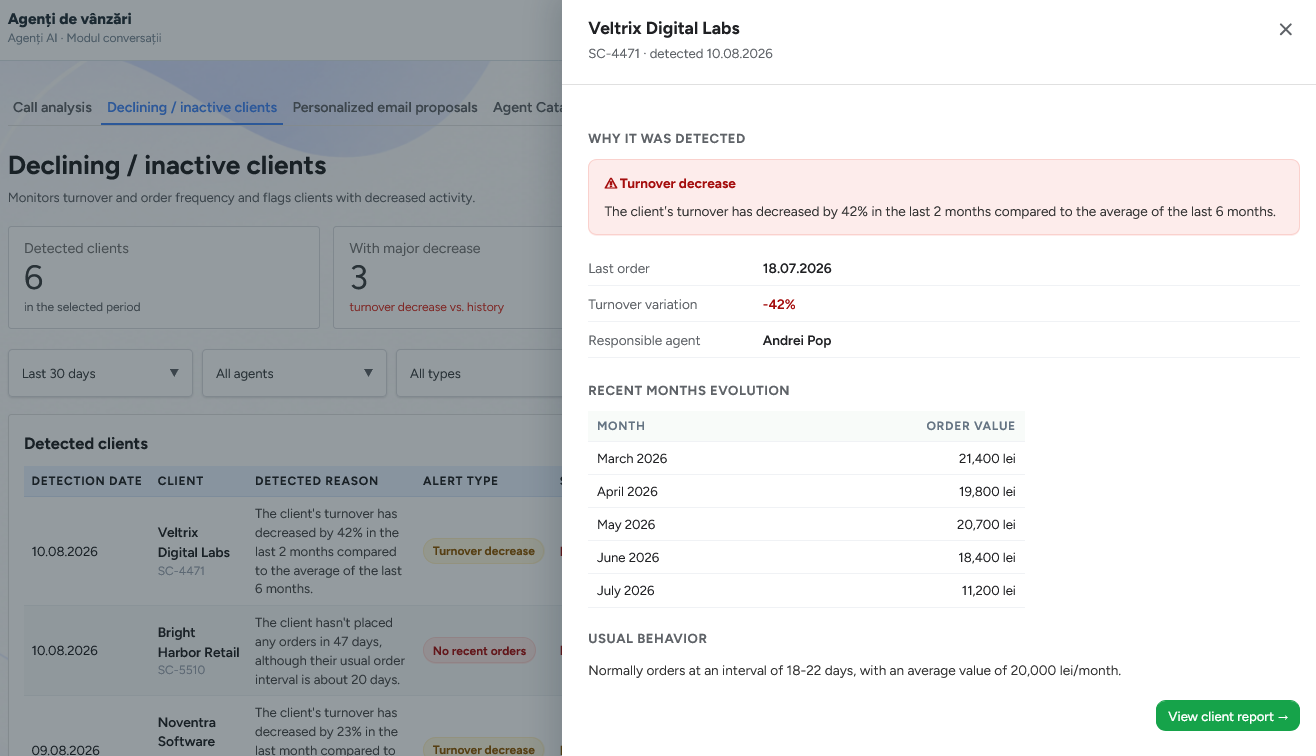
An AI agent detects that a customer's order value dropped by 42% compared to their usual behavior, identifies the products with the biggest decline, and can even prepare a draft re-engagement message.
The platform's user sees both the AI's conclusion and the data it is based on. The message can be prepared for sending by email or WhatsApp.
3. Replenishment: Which Products Need to Be Ordered from the Supplier?
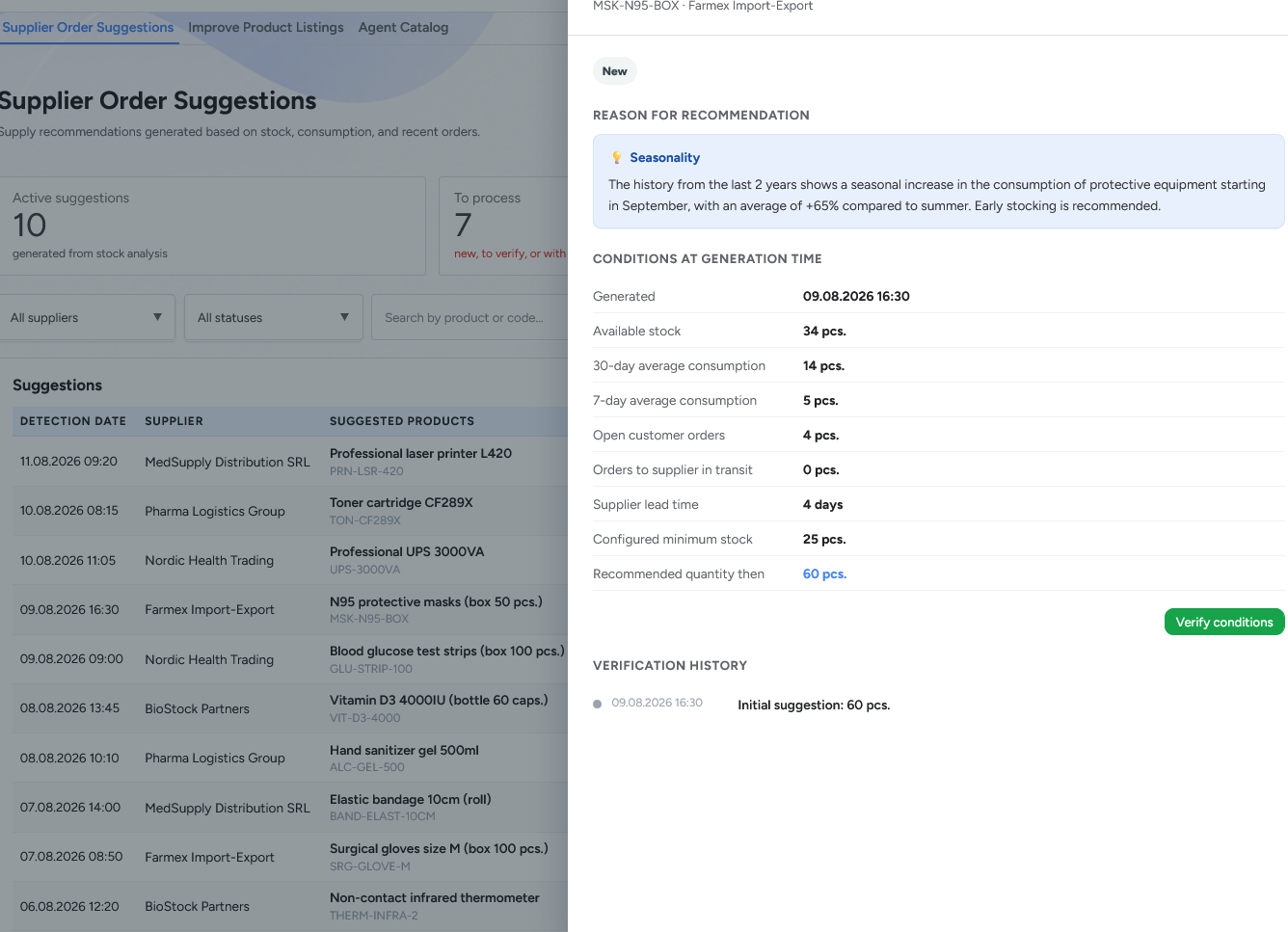
The AI agent formulates a replenishment recommendation based on current stock, consumption over the last 30 days, customer orders still open, supplier orders in transit, and lead time defined in the ERP. The result isn't just a short message saying "order 40 units of product X," but an explained recommendation tied to the conditions in place at the moment it was generated.
Conditions can change after generation. An initial recommendation can be re-checked before the user acts on it and will be recalculated if new orders came in, goods were received, or stock changed in the meantime.
4. Market Positioning: How Do My Products Compare to Competitors?
The same logic also supports the company's pricing strategy. The AI agent can compare products against the market, highlight where the price is above or below the tracked benchmark, and generate recommendations to increase, decrease, maintain, or monitor the price more frequently.
For this, the company needs market data by category, or preferably by product.
See a case study on how we built a price comparison tool
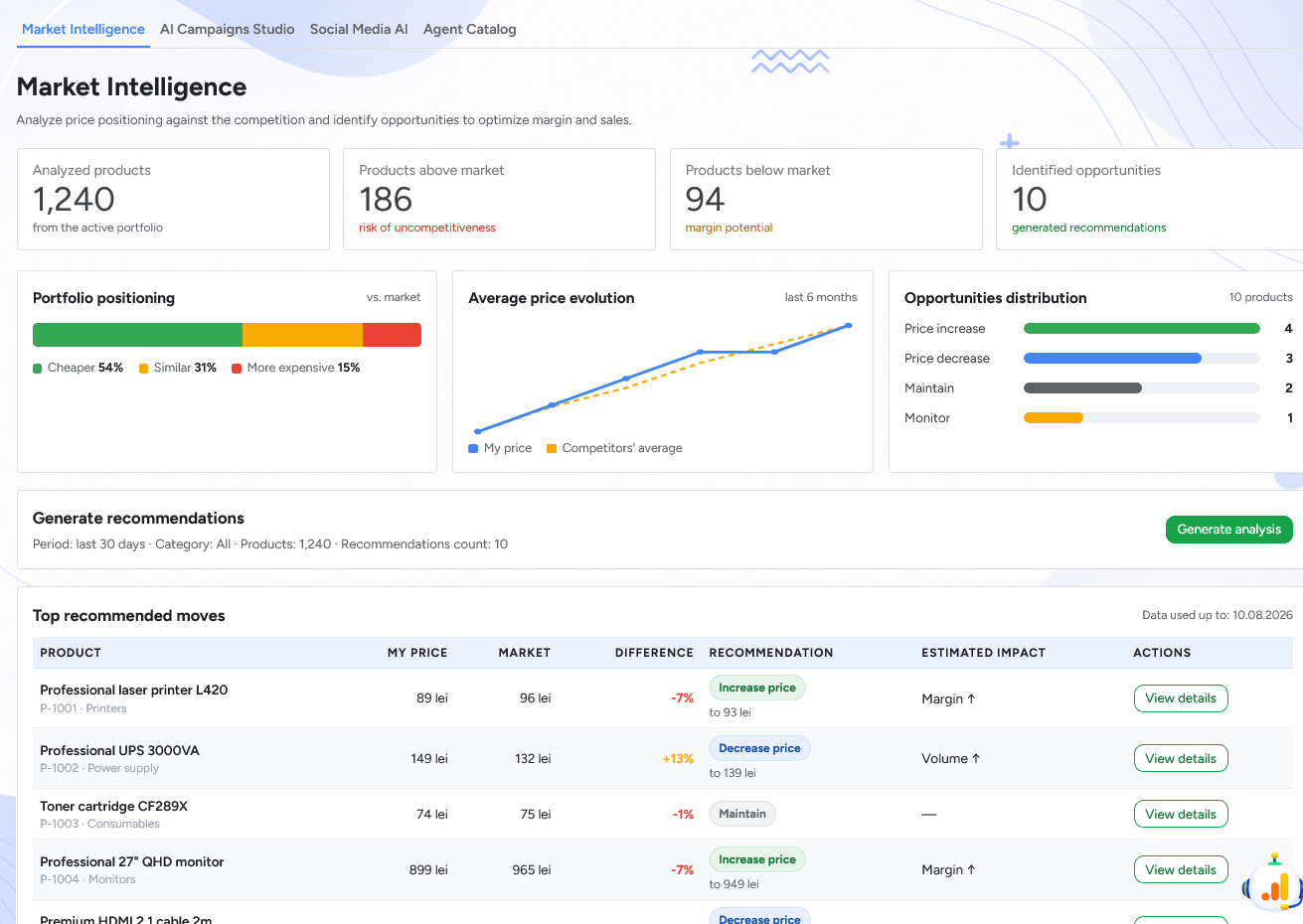
The AI agents in AI Sales 2.0 detect the company's situation, delegate activities to specialized agents, and prepare the action for the user.
In the OPTI architecture awarded by ANIS in 2026, the company can protect important data such as its pricing policy so it doesn't end up in the AI model provider's infrastructure. The company's data stays the company's.
Read a case study for AI Sales 1.0: reducing quoting time
5. How Do You Oversee AI Agents and Their Costs?
As the number of agents grows, actions and costs need to be overseen. We need to know which agent ran, how many times it was executed, and at what usage cost. The commercial impact is measured separately through the company's KPIs: recovered sales, time saved, avoided stockouts, or margin.
Observability: See Which Agents Are Running
In AI Sales 2.0 we give the company the ability to monitor costs. The number of runs, the success rate, and the estimated costs are all transparent.
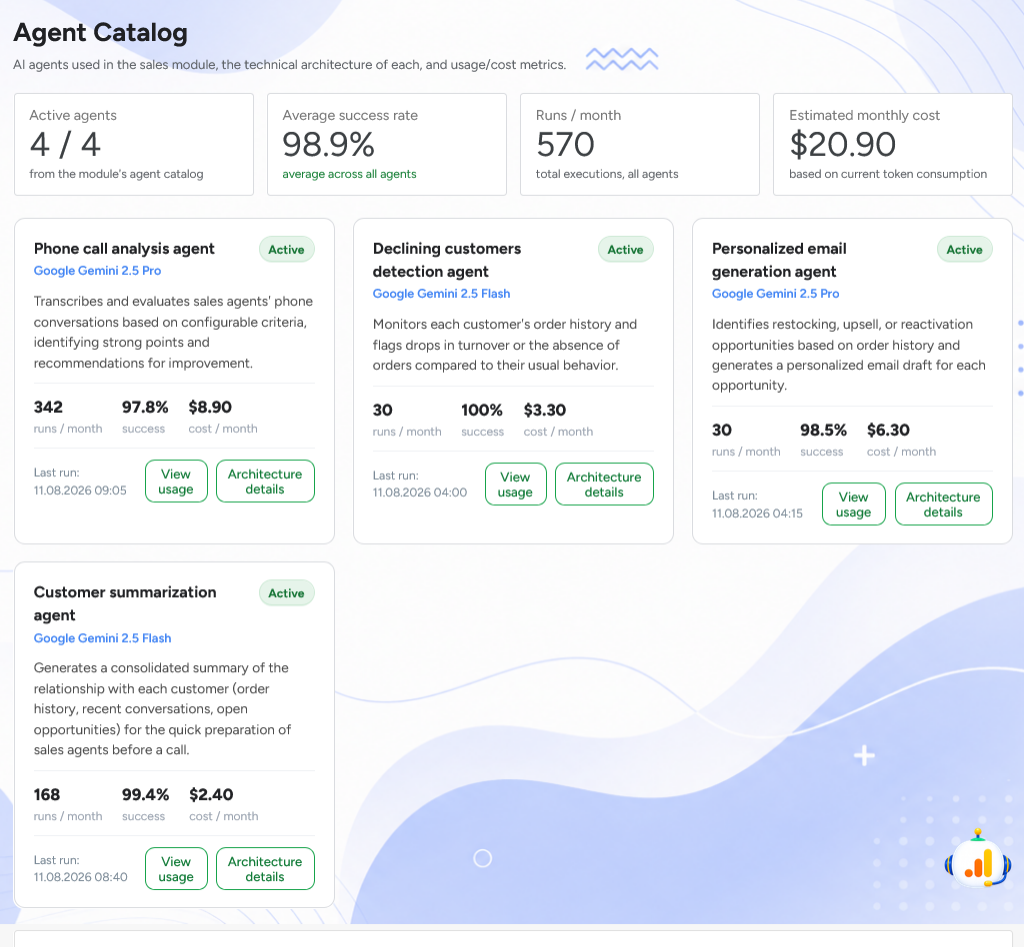
Specialized Agents Instead of a Monolithic Agent
In AI Sales 2.0, the "Sales" function is broken down into specialized agents built on Google Cloud services. One analyzes phone conversations. Another detects declining customers. Another prepares personalized emails. Yet another builds the customer summary before an interaction.
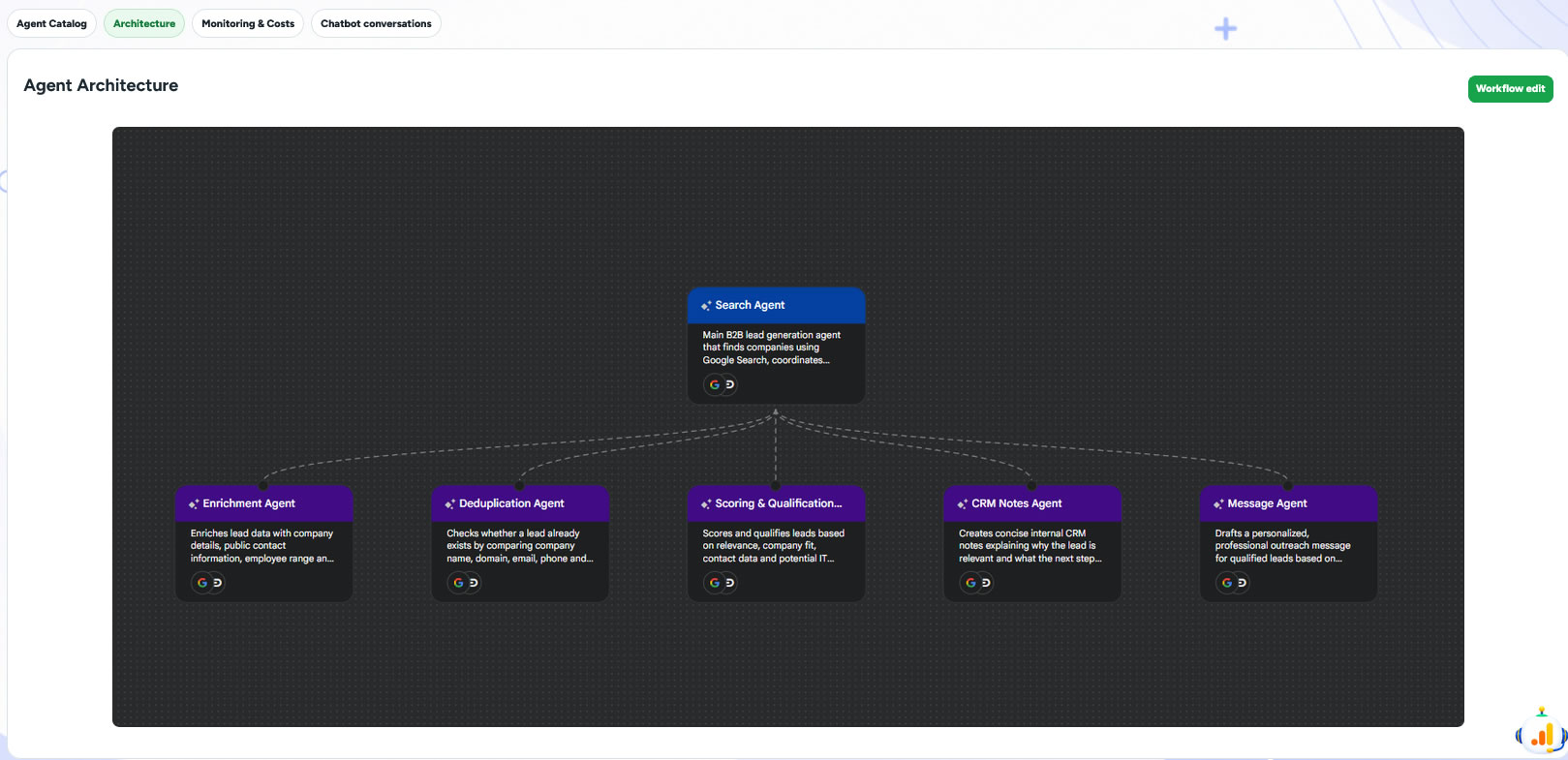
Optimizing Through Automation
OPTI doesn't use AI where a simple rule already solves the problem. Depending on complexity, moving from automation to an AI agent and then to a group of AI agents is justified by the commercial results.
When Do We Use Automations, AI Agents, and Groups of AI Agents?
AUTOMATION                AI AGENT                  GROUP OF AGENTS
known rule           →    interprets          →     coordinates tasks
invoice → alert           customer → recommendation  end-to-end prospecting
In every case, the final decision belongs to the company. As mentioned, the system can identify a customer to re-engage after a period of decline, but it doesn't have to send the email on its own. This is the Human-in-the-Loop model: AI investigates and speeds up the process, while the human keeps control over high-impact actions.
For a distributor, we can start with a single flow (declining customers, replenishment, or pricing) on real data, then expand after validation.