

What our team has already connected around HubSpot
Automated invoicing from HubSpot
Governance and automation across HubSpot
CRM workflows connected to external services
Connect HubSpot to the systems that run your business
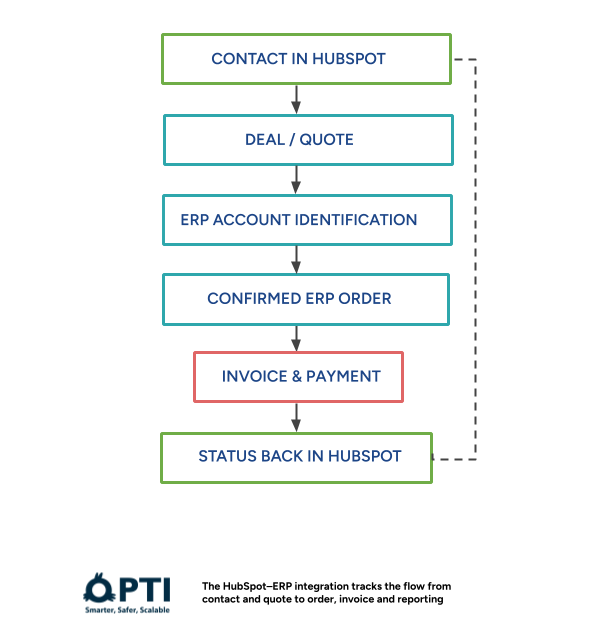
ERP ↔ HubSpot
Finance & billing
eCommerce & orders
Proprietary software & APIs
Data, BI & AI
Governance & discipline
Four decisions that define a reliable HubSpot integration
| Simple connector | Custom integration | OPTI approach | |
|---|---|---|---|
| Best fit | Standard objects and workflows | Custom data models or operational processes | We use native where it fits; we customize only the missing layer |
| Data ownership | Often assumed by the connector | Must be designed explicitly | We define ownership down to field level where needed |
| Sync model | Predefined schedules or triggers | Real-time, scheduled or event-driven | We choose based on business impact, volume and failure tolerance |
| Business rules | Limited to connector options | Can reflect ERP / finance / approval logic | We keep rules close to the system that should own them |
| Operations | Vendor-managed behavior | Requires monitoring and ownership | Logging, retries, reconciliation, documentation and handover |
Custom only when needed
CRM plus software engineering
Built for the mid-market
Individual Google Cloud Engineer / Architect certifications






Take the integration, or add the capacity
Fixed-scope integration delivery
- source and target system assessment
- object / field mapping and ownership rules
- pilot, reconciliation and production rollout
- documentation and handover
Embedded HubSpot + integration capacity
- we work inside your procedures and repositories
- we support the ongoing HubSpot and integration backlog
- we scale capacity according to the agreed allocation
- senior-led technical discipline
Complete HubSpot Migration, Step by Step
Receive the material
Fill in the form and we will send the material to your email.
Quick Questions
Does HubSpot replace the ERP or integrate with it?
In most projects, HubSpot and the ERP have different roles. HubSpot manages customer-facing and CRM processes, while the ERP remains the source for operational data such as products, stock, orders, invoices or commercial conditions. We explicitly define the system of record for each object and synchronize only the data that is needed.
Do you use native integrations or custom development?
We prefer a native integration when it reliably covers the requirement. We build APIs, middleware, webhooks or other custom components when business processes, rules, data volumes or proprietary systems go beyond the capabilities of a standard connector.
Does a HubSpot ERP integration need to be two-way?
Not necessarily. Some data should move in one direction while other data may require bidirectional synchronization. We define ownership separately for companies, contacts, products, pricing, stock, quotes, orders, invoices and other objects to avoid conflicts and circular updates.
Can you connect HubSpot to systems other than ERP?
Yes. Integrations can include billing and invoicing, ecommerce, proprietary applications, messaging services, databases, BI and data warehouses, Google Cloud, and other external APIs and services. The integration is designed around the business process, not only around a specific product.
How do you handle security and data ownership?
NDA-based work is standard. We use least-privilege access, clear system and repository ownership, logging and documentation, with delivery discipline aligned with our ISO 27001 and ISO 9001 certifications. IP ownership and responsibilities are defined contractually.