


OPTI Clients

 Hervis Sports
 Pluxee


 INSMC
 Old Prints
 Zentiva
 Origin Data
 Winmasters
 CNAS
 ART
Where does information get fragmented?
Where data and processes get fragmented
Data has different sources and rules
Integrations are critical, but sensitive
AI can help without taking over decisions
Medical databases are fragmented
A distributor works with customers, SKUs, prices and stock. A clinician works with patients, visits, results and medication. Research uses studies, cohorts and experiments. Procurement uses suppliers, contracts and assets.
This fragmentation is not just technical debt; it is essential in pharma.
Software architecture identifies the data that can be centralized while preserving traceability.

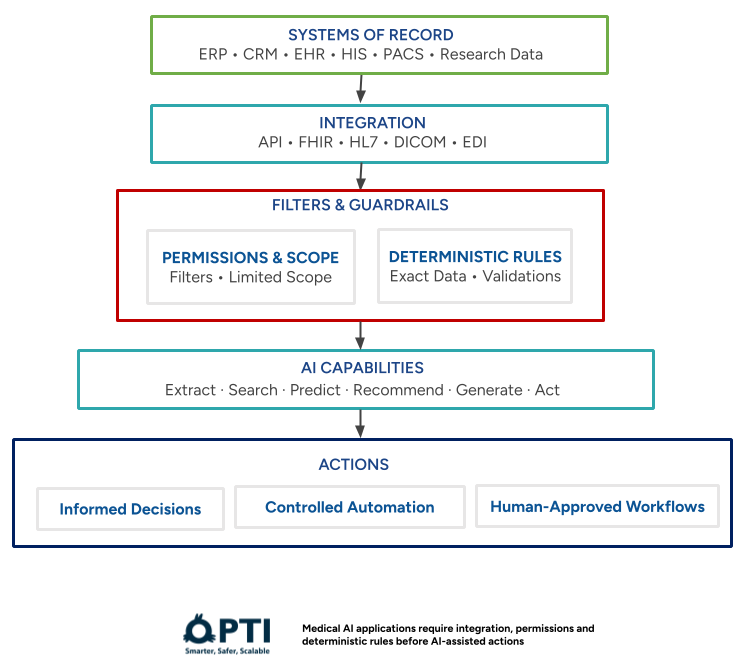
Core systems take priority
For each application, we first establish where the authoritative information lives, how it can be accessed, who can use it and which rules must be followed.
AI can be integrated under strict control for extraction, search, forecasting, recommendations, generation or auditable actions.
- Core system: ERP, CRM, EHR/PACS or research environment
- Integrations: API, FHIR, DICOM, EDI or SQL, as applicable
- Permissions: access only for the necessary purpose
- Determinism: clinical/commercial rules remain verifiable
- Audit: logs, traceability and identifier preservation
AI can be most useful for fast search
Some of the most useful AI applications do not make decisions at all. They quickly find relevant information, structure documents or prepare a result for a professional who reviews it.
The sources are clear, the output can be traced, and the responsible person stays in control.

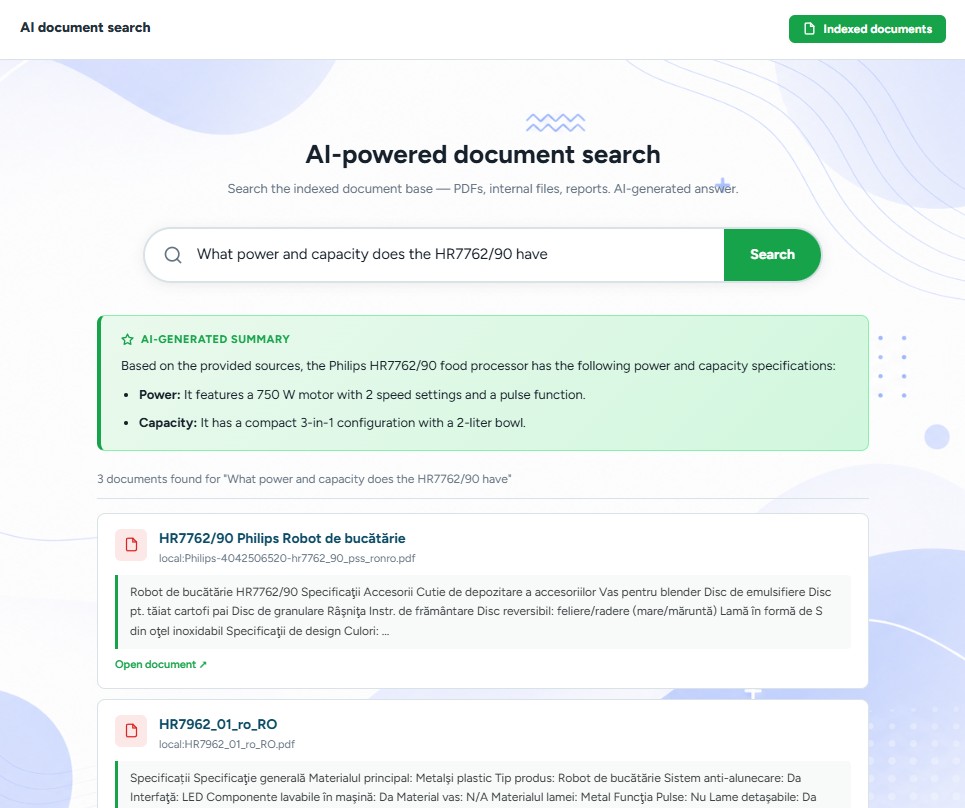
What does the document AI and AI search support module look like?
- indexing and search across fragmented sources
- answers tied to the source document and passage
- comparison and synthesis across relevant sources
- permissions and separation between data collections
- useful for support, operations and knowledge transfer
Relevant services
Software & Modernization
Security and resilience
Success Stories
 Case Study: Advanced Lead Tracking in HubSpot

 Case Study: Delivering Cybersecurity Awareness Training
How we work
Purpose and responsibility
Systems and data
Controlled architecture
Pilot and validation
Launch and audit
Three ways to connect data and processes
| Integrate existing systems | Add controlled AI | Build a new workflow | |
|---|---|---|---|
| Best for | Data is split across systems and partners | There are large volumes of documents or information | The current flow cannot be supported by standard products |
| What we keep | ERP, CRM, EHR/HIS and other core systems | Authoritative sources and existing rules | Existing clinical/commercial systems |
| What we add | API, FHIR where applicable, integration and audit | Search/RAG, document AI, auditable recommendations | Portal, application, workflow or custom integration |
| First outcome | Data available where it is needed | AI applications with defined scope and permissions | A controlled end-to-end digital process |
| Typical example | CRM ↔ ERP or EHR ↔ application | Document → structured data / knowledge assistant | Patient, commercial or operational portal |
Healthcare Data Integration in 2026: 24 AI Applications Across Clinical, Pharma and Enterprise Uses
Receive the material
Fill in the form and we will send the material to your email.
What our clients say

Quick Questions
Are the software solutions you develop compliant with GDPR and HIPAA?
Yes, all our medical software solutions are designed to be compliant with strict GDPR and HIPAA regulations, ensuring patient data security and confidentiality. We hold an ISO 27001 certification for information security management.
What features do you offer for a patient portal?
A patient portal can include online appointments, secure access to medical results, encrypted communication with doctors, treatment plan management, and educational resources, all within an intuitive and secure interface.
How can you support data management for clinical trials?
We develop custom CRM systems to optimize the collection and management of data from clinical trials. Our solutions allow for precise tracking of participant responses and facilitate rapid analysis of results.
Can you integrate the new software with the medical ERP system we already use?
Yes, we specialize in interconnecting databases and integrating new software with existing medical ERP systems. We ensure a unified and efficient data flow, eliminating information silos.
Relevant Insights & Guides