



Can you prove your critical systems can be restored?

When does a resilience program make sense
Infrastructure has grown without monitoring
You have backups, but restore is untested
There are opportunities for securing/hardening.
NIS2 / ISO / audit requirements
Patches and vulnerabilities
Risk of major gridlock
Resilience applied in real systems
We offer both proactive security programs and the actual operation of IT infrastructure. In real-world projects we implement system hardening, MFA, edge security and organizational training.
- AI-ready infrastructure: We added MFA and strengthened SPF/DKIM/DMARC protections, eliminating spoofing incidents.
- Availability: With Cloudflare, we have reached up to 95% of web traffic served from the edge for e-commerce platforms.
- Training: We developed a four-week program for Bucharest Bar Association employees, covering phishing, malware and GDPR.
- Passive security: OPTI’s award-winning platform, MrBenny.com, is dedicated to vulnerability and risk management.
- Certifications: OPTI is certified to ISO 27001 (information security), ISO 9001 (quality) and ISO 42001 (AI).
What we deliver
Inventory & risk assessment
Hardening, IAM & MFA
Patch management
Restore & continuity
Incident response & tabletop
Infrastructure and DevOps
Additional services
Software development
Modernization & Fractional CTO
Industries where we apply it
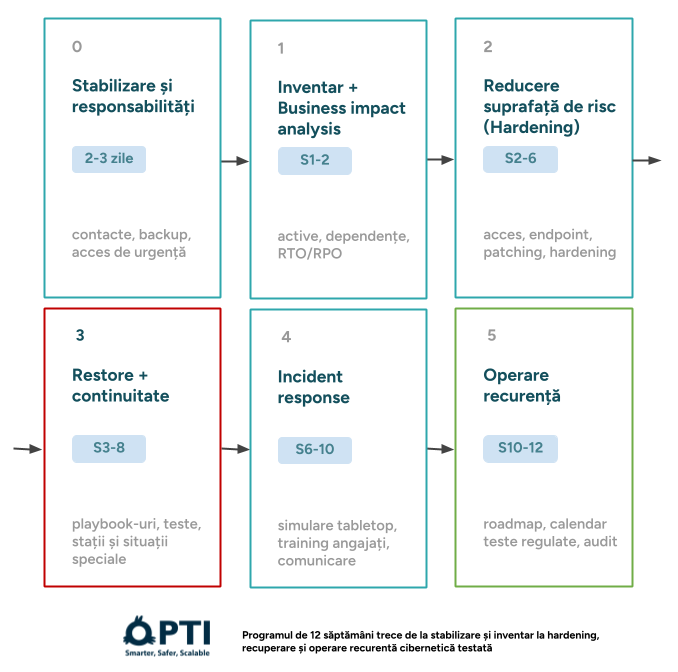
How we develop resilience
Phase 0: Stabilization and responsibilities
Phase 1: Inventory and Dependencies / BIA
Phase 2: Hardening and reducing the attack surface
Phase 3: Restore and end-to-end tests
Phase 4: Incident response and tabletop exercise
Phase 5: Recurring operation and improvement
You reduce a risk area or develop ongoing resilience
Purpose-defined security / resilience program
- asset inventory and BIA analysis
- hardening, MFA and segmentation
- EDR/XDR and IDS assessment
- backup, restore and continuity tests
- playbooks, tabletop and final report
Recurring security and infrastructure support
- vulnerability scanning and patching
- EDR/XDR monitoring and alerts
- backup and restore checks
- review of access, networks and configurations
- incident support and remediation plan
Twenty years in the software industry






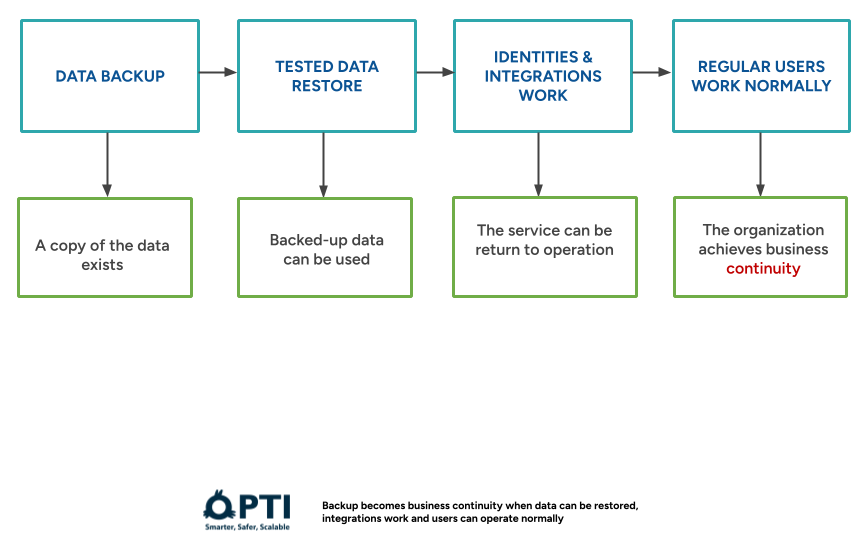
Backup ≠ Continuity. 6-Phase Model Program for Cyber Resilience in 12 Weeks
Receive the material
Fill in the form and we will send the material to your email.
Quick Questions
What is the difference between EDR, XDR and an IDS?
EDR monitors and protects endpoints, XDR correlates security signals across multiple components, while an IDS detects suspicious network activity. OPTI can assess solutions such as Bitdefender GravityZone XDR and IDS sensors based on the existing infrastructure.
How can we verify whether our backups actually support business continuity?
Having backups does not guarantee service recovery. We test the restoration of data, applications, identities and integrations based on a Business Impact Analysis (BIA) and RTO/RPO objectives. The result is a documented and tested recovery process.
What does a 12-week cyber resilience program include?
The OPTI program follows six phases: stabilization, inventory and BIA, hardening, recovery testing, incident response and recurring operations. Specific activities depend on the organization's risks, infrastructure and available resources.
How can we prepare for NIS2 and security audits without replacing our infrastructure?
We start with asset inventory, risk assessment and a review of existing controls, then prioritize MFA, patching, network segmentation, monitoring and continuity. Measures can be introduced gradually; NIS2 applicability and legal compliance require separate assessment.
Relevant Insights & Guides