


OPTI Clients

 Hervis Sports
 Pluxee


 INSMC
 Old Prints
 Zentiva
 Origin Data
 Winmasters
 CNAS
 ART
Where is time lost in quoting?
Where distribution capacity can grow
The sales team can be supported
AI can recommend technical products
Data from fragmented systems can be unified
The ERP knows the commercial truth. But it does not always know how to sell.
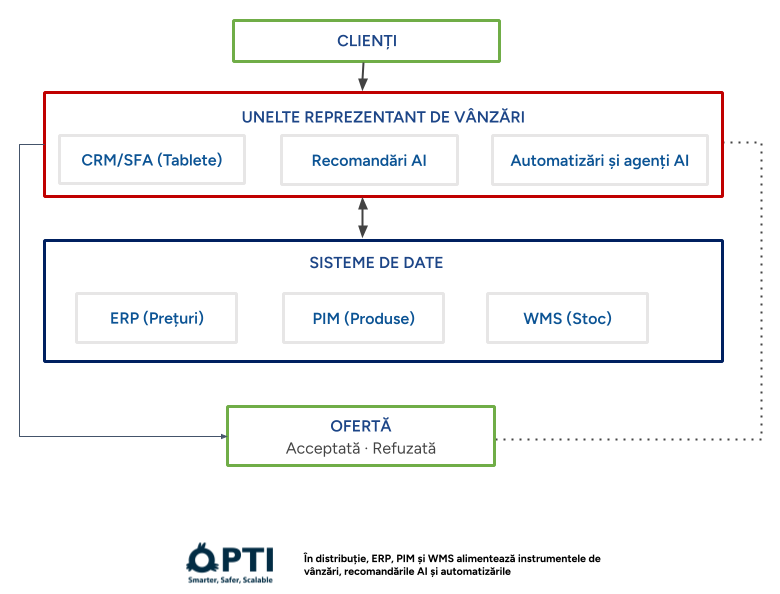
In distribution, the ERP knows the contract price, stock, credit and past orders. The CRM knows the customer relationship. The WMS knows what can be delivered. The catalog knows which products exist.
The problem starts when the sales rep has to rebuild this picture manually for every request.
That is why the value does not come from replacing the ERP, but from connecting these sources into a flow that can quickly answer commercial questions: which product fits, what is available, what alternative exists and what can be recommended without breaking margin or pricing rules.

AI on top of existing systems, not in their place
We separate what can be recommended from what must be verified accurately.
The customer's request can be understood with AI. Customer identity, product code, stock, price, discount and credit limit are validated in the company's systems before the action.
- ERP / WMS / CRM remain the source of truth
- AI interprets, searches, recommends or prepares the action
- Commercial rules are checked deterministically
- Important actions remain approvable and auditable
The company's history can become a competitive advantage
A distributor with years of orders already has a valuable knowledge base: what each customer buys, which products substitute for one another, which combinations appear together and at what intervals customers restock.
AI is useful when it turns this history from an archive into context for quoting, bundles, upsell, forecasting and next-best-action.
With one condition: the data and commercial rules must be cleaned and correlated for success.

What does the fast smart selling module look like?
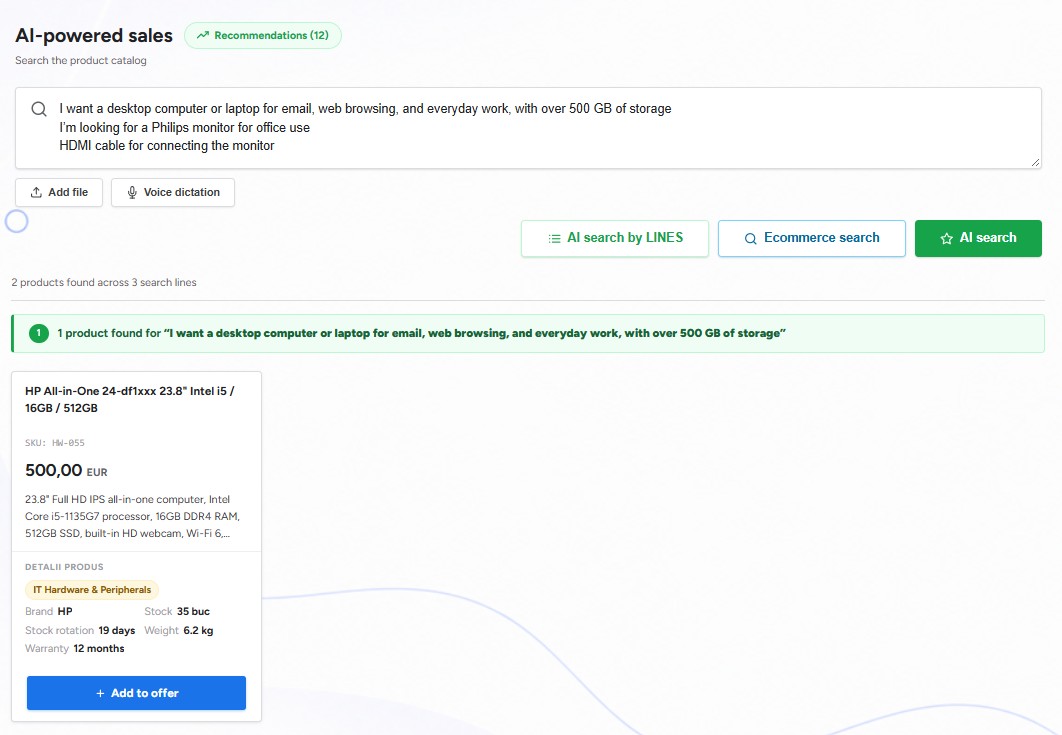
- product search and matching across large catalogs
- price, stock and commercial rules pulled from authorized sources
- recommendations for alternative, compatible or complementary products
- quote or order lines prepared for validation
- shorter response time for the sales team
Relevant services
Automation & AI agents
Data, Analytics & AI
HubSpot, CRM & ERP
Success Stories
 B2B eCommerce Portals Integrated with SocrateCloud and Pluriva
 Case Study: Price Intelligence - Monitoring Prices and Stock with Google Cloud and AI
 Case Study: Accounting and Advanced Financial Reporting System (Rescheduling Module)
How we work
Process and KPI
Systems and rules
Controlled pilot
Integration into the workflow
Measurement and expansion
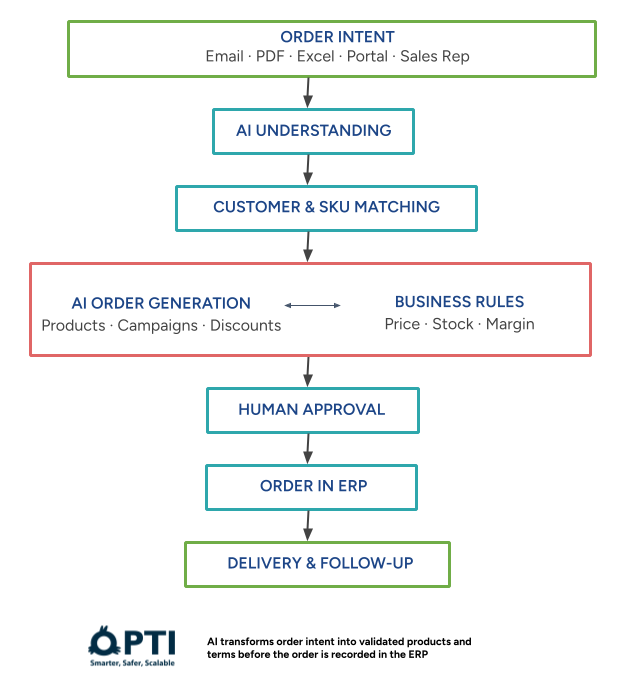
Three ways to modernize distribution
| Integrate legacy systems | Add AI & automation | Use a new channel | |
|---|---|---|---|
| Best for | Functional but isolated ERP, CRM and WMS | Manual processes on top of data already available | Portals or apps that limit selling |
| What we keep | ERP, pricing, stock and commercial rules | Core systems and existing rules | The ERP and operational core |
| What we add | APIs, synchronization, master data | Order-taking, recommendations, forecasting, agents | B2B portal, order-taking, self-service, SFA apps |
| First outcome | The same customer, product and stock across all systems | An automated, measurable commercial process | A complete digital flow for the customer or sales rep |
| Typical example | ERP ↔ CRM ↔ WMS | Email/PDF → AI → ERP | B2B portal ↔ ERP |
The "Recommendations, Upsell, and Rules" guide
Receive the material
Fill in the form and we will send the material to your email.
What our clients say



Quick Questions
Can we integrate a B2B portal or AI agents with our existing ERP?
Yes. OPTI develops B2B portals, quoting applications and AI agents connected to ERP, CRM and WMS through APIs. Product, inventory, pricing and order data can remain synchronized without necessarily replacing existing systems.
How can we automate quoting for technical products with complex pricing and discounts?
We combine intelligent catalog search with customer-specific price lists, contractual discounts, margin limits and approval workflows. AI identifies the requested products, while business rules validate quotes before submission.
How can we reduce inventory errors and improve replenishment?
We integrate ERP, WMS, order and sales history data to identify stockouts, excess inventory and replenishment needs. Forecasting models and automated alerts support procurement decisions.
Do we need to replace our ERP to introduce AI into distribution?
No. AI can usually be introduced through an integration layer connected to the existing ERP. Intelligent quoting, product recommendations, order automation and commercial reporting can be implemented gradually.
Relevant Insights & Guides