


OPTI Clients

 Hervis Sports
 Pluxee


 INSMC
 Old Prints
 Zentiva
 Origin Data
 Winmasters
 CNAS
 ART
Where are you losing conversion?
Where conversion or margin is lost
The website, CRM and ERP say different things
The catalog is large, but hard to explore
Conversion is limited by technology
Good UX is only the visible part
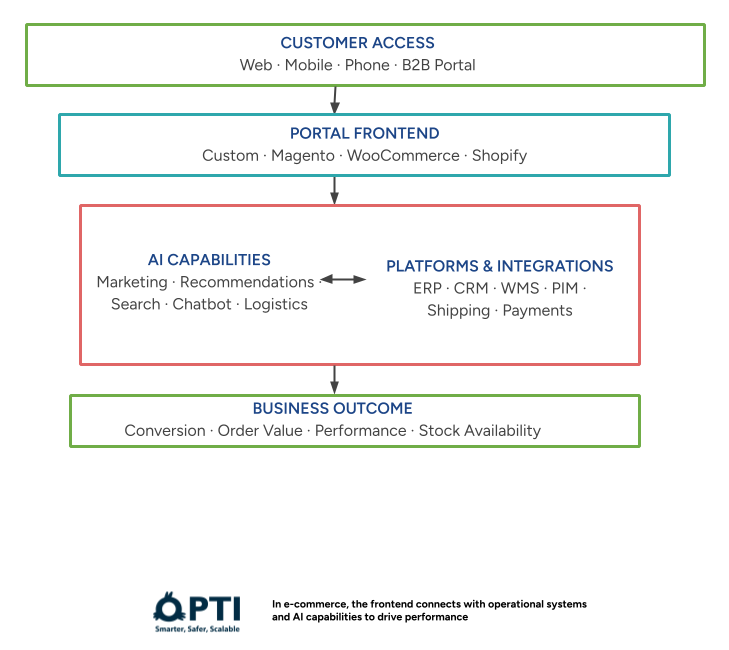
The customer sees a website. Behind it are the catalog, PIM, ERP, stock, WMS, pricing, CRM, payments, couriers and reporting.
B2B eCommerce projects require system integration to unify data and commercial flows.

UX up front, core systems behind
The eCommerce platform orchestrates the customer experience. The ERP and WMS remain the source of truth for transactions. The CRM holds the customer relationship.
Search and AI add valuable personalization and recommendations.
- Catalog and content kept in sync
- Stock and price verified in the authoritative systems
- Search and recommendations on top of clean data
- Automated order-to-delivery
- Performance and uptime as priorities, including on Black Friday
At scale, search becomes part of the sale
When the catalog reaches tens or hundreds of thousands of products, classic navigation is no longer enough.
The search engine has to understand product names, attributes, compatibilities and customer intent. Recommendations then have to respect stock, margin and commercial rules.
AI helps align commercial policy with buyer intent.

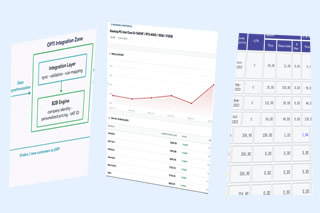
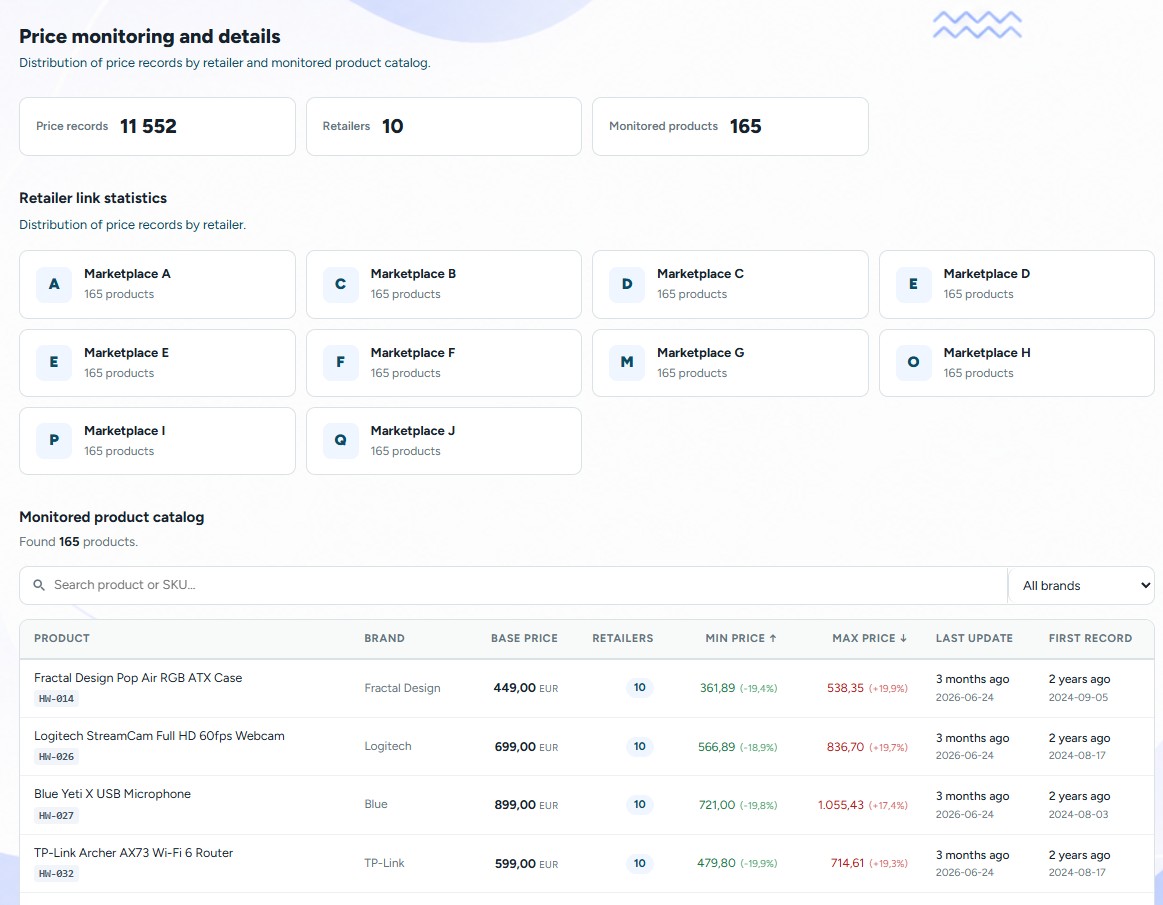
What does the Price Intelligence module look like?
- relevant comparison of products and offers
- monitoring of price positioning and availability
- rules by margin, category or segment
- flagging of deviations for quick action
- a solid foundation for pricing and marketing
Relevant services
Data, Analytics & AI
Automation & AI
Success Stories
 B2B eCommerce Portals Integrated with SocrateCloud and Pluriva
 Case Study: Price Intelligence - Monitoring Prices and Stock with Google Cloud and AI
 Case Study: Implementing schema.org / JSON-LD for GEO (AI Search) in B2B and eCommerce
How we work
Model and KPI
Systems and catalog
Architecture and experience
Build & launch
Measure & improve
Three ways to grow an eCommerce portal
| Connect to operations | Add AI | Build the complete experience | |
|---|---|---|---|
| Best for | The store is separate from the ERP, WMS or CRM | You have traffic and transactions, but little personalization | The standard platform limits the commercial model |
| What we keep | ERP, catalog, stock, CRM | The shop and existing systems | The backend and useful core systems |
| What we add | Catalog, stock, price and order sync | Search, recommendations, pricing, NBA | B2B portal, checkout or custom features |
| First outcome | Consistent commercial data across all channels | A measurable improvement in conversion/AOV/efficiency | A buying flow adapted to the business |
| Typical example | WooCommerce/Shopify ↔ ERP/WMS | AI search + recommendations | B2B portal with price and stock from the ERP |
The "Recommendations, Upsell, and Rules" guide
Receive the material
Fill in the form and we will send the material to your email.
What our clients say



Quick Questions
Which eCommerce platform do you recommend: WooCommerce, Shopify, or a custom solution?
The recommendation depends on your business complexity. WooCommerce is flexible, Shopify is user-friendly, and a custom solution offers unique scalability and features. We analyze your needs to choose the best option.
How do you integrate an online store with my existing ERP or WMS system?
We create custom integrations via API or other methods to sync stock, orders, customers, and prices in real-time between the eCommerce platform and your ERP/WMS (Warehouse Management System).
Can you integrate Romanian payment processors like Netopia?
Yes, we have extensive experience integrating the main Romanian payment processors, including Netopia, mobilPay, or LibraPay, alongside international solutions like Stripe, ensuring a smooth payment experience for your customers.
How do you ensure the performance of a high-traffic online store?
We use caching technologies (Varnish, Redis), Content Delivery Networks (CDNs) like Cloudflare, and a scalable cloud infrastructure (Google Cloud) to guarantee fast loading speeds and high availability (uptime) even during peak periods.
Relevant Insights & Guides