



OPTI Clients

 Hervis Sports
 Pluxee


 INSMC
 Old Prints
 Zentiva
 Origin Data
 Winmasters
 CNAS
 ART
Which financial process should be modernized first?
Where control is lost in financial processes
The data does not correlate perfectly
The rules are complex and hard to automate
Analysis takes too much manual work
The figures used must be explainable
A financial application does not end with displaying a result. You have to be able to reconstruct where the information came from.
A payment can have an allocation rule. A debt can be current or rescheduled. A report can combine data from several systems. A score calculated by AI has to keep the link to the documents that produced it.

We add intelligence on top of the accurate transaction system
Existing systems remain the source of truth for transactions. An integration and data layer can aggregate information for reporting, analysis and AI. Agents can interpret documents or recommend actions, but rules and operations with financial impact remain auditable.
- ERP, accounting, CRM and payment systems remain the source of truth
- Data is reconciled before analysis
- Financial rules are implemented deterministically
- AI interprets and recommends
- Important actions have approvals and an audit trail
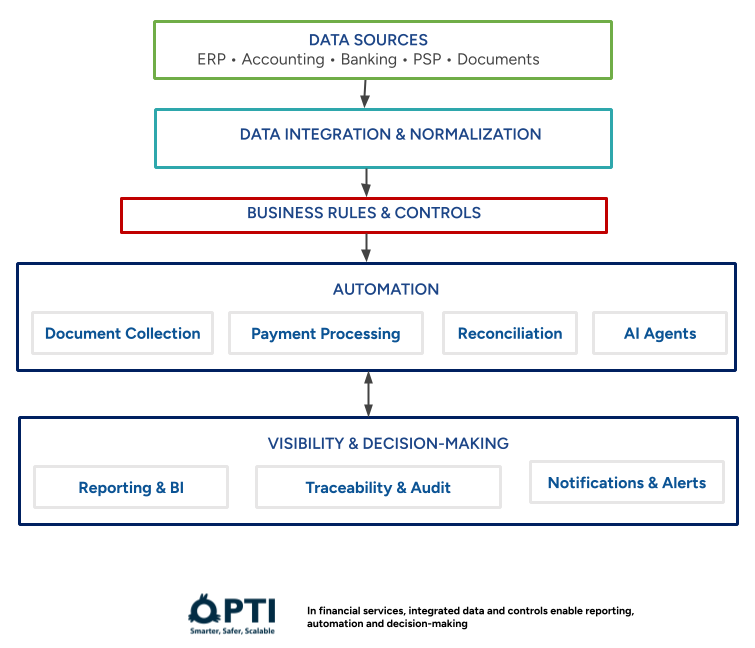
How financial precision combines with AI speed
In a financial research project, AI can read hundreds of pages, extract factors, compare signals and generate a score. In accounting, a payment of $10,000 will always be exactly $10,000, allocated according to a standard, verifiable rule.
These are two different types of software that we combine through a hybrid architecture. AI for unstructured information and interpretation, and transactional systems for approvals and operations with financial consequences.

What does the conversational analytics and reporting module look like?
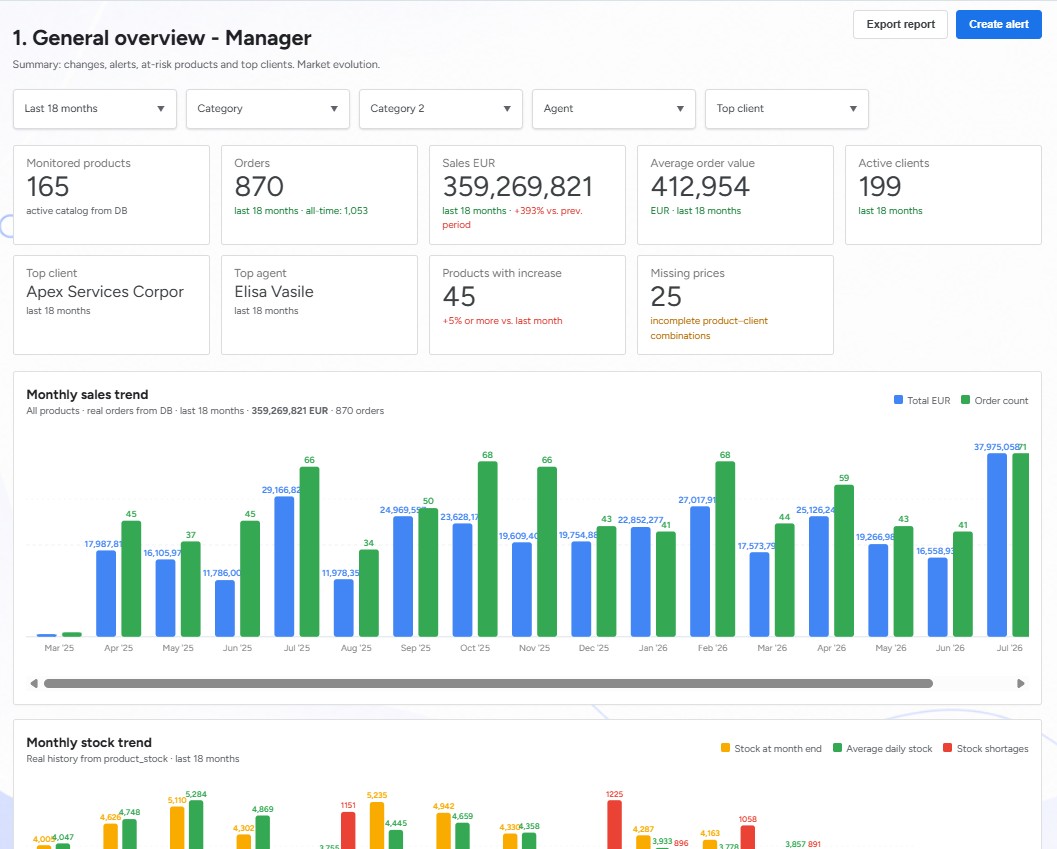
- natural-language questions over data and KPIs
- drill-down by entities, periods and areas of interest
- answers connected to the calculation logic
- support for management and operational reporting
- a basis for informed decisions
Relevant services
Data, Analytics & AI
Software development
Automation and AI
Success Stories
 Case Study: Price Intelligence - Monitoring Prices and Stock with Google Cloud and AI
 Case Study: Accounting and Advanced Financial Reporting System (Rescheduling Module)
 Case Study: Financial Sentiment Analysis with GenAI & Google Cloud
How we work
Process and responsibility
Systems and rules
Data and architecture
Pilot and validation
Production and audit
Three ways to modernize financial processes
| Automate the flow | Connect the data | Add AI | |
|---|---|---|---|
| Best when | The process is manual and repetitive | Reporting requires reconciliation | The volume of documents/analysis is too large |
| Examples | Billing, payments, approvals | Accounting + ERP + CRM | Research, document intelligence, explanations |
| First outcome | Fewer manual operations | A shared version of the data | Reduced analysis time |
| Control | Deterministic rules | Data model + audit | Human approval + limits |
| You can start with | One workflow | One dashboard/KPI | A corpus of analysis reports |
The "AI Architecture for B2B in 2026" presentation
Receive the material
Fill in the form and we will send the material to your email.
What our clients say


Quick Questions
Do we need to replace our ERP or accounting system to add AI?
No. ERP, accounting, CRM and payment systems remain the systems of record. We build an integration and data layer on top of them for reporting, analysis and AI, while operations with financial effect stay in the existing systems.
Where is AI useful in a financial process, and where is it not?
AI is useful for unstructured information: reading documents, extracting factors, comparing signals and producing scores or explanations. Amounts, allocations, access rights and approvals stay implemented as deterministic, verifiable rules.
How do you keep a figure or an AI-generated result traceable?
Data is reconciled before analysis, financial rules are explicit, and important actions have approval and an audit trail. A score calculated by AI keeps its link to the documents and data that produced it.
Which financial process can we start with?
With a single workflow or indicator: a billing, payment or approval flow, a dashboard that requires data reconciliation, or a set of documents for analysis. We start with a scoped pilot, validate the results and the rules, then move to production in a controlled way.
Relevant Insights & Guides