

Already on Google Cloud but short on capacity?
When it makes sense to adopt the cloud
The platforms must be migrated or modernized.
Data needs to be centralized in BigQuery
AI agents connected to organizational data
Looking for cost control in GCP
Looking for certified skills
Looking for security and auditing
What we built with Google Cloud
- Financial GenAI: four years of reports, daily analysis in four minutes.
- Gaming analytics: BigQuery for hundreds of thousands of players.
- Quoting: the integration of Gemini with Entersoft has reduced the quoting time by 68%.
- Price intelligence: BigQuery + Gemini for price, stock and margin.
- Commercial automation: HubSpot and Google Cloud integrated into quoting workflows.
What we deliver
Landing Zone & Lift and Shift
Application modernization
BigQuery & data platforms
Agentic Platform & Gemini
Security, IAM & observability
Cost optimization & support
Additional services
Data, Analytics & AI
Automation & AI agents
Software development
Industries where we apply it
How we implement cloud
Workload and outcome
Architecture and cost
Landing zone and data
Build, migration and testing
Go-live and optimization
Take the outcome, or add the capacity
Defined-scope Google Cloud project
- audit of workload and cost estimation
- IAM, VPC and landing zone architecture
- Cloud Run, Cloud SQL or BigQuery
- testing, security and monitoring
- documentation and handover
Embedded Google Cloud capacity
- cloud development and administration
- BigQuery, SQL and data pipelines
- Cloud Run, GKE and infrastructure
- Gemini, Agent Platform and AI applications
- FinOps and Senior Oversight
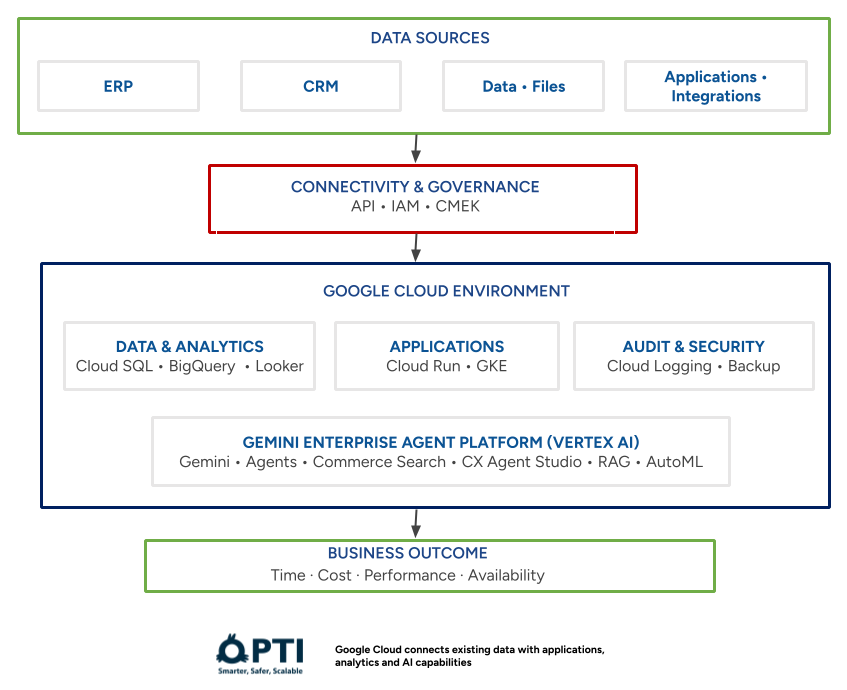
We integrate technology with existing business systems






The "Recommendations, Upsell, and Rules" guide
Receive the material
Fill in the form and we will send the material to your email.
Quick Questions
What should I choose between GKE and Cloud Run?
Use Cloud Run for most stateless services (APIs, webhooks) for speed and optimized costs. Choose GKE (Kubernetes) for complex workloads that require fine-grained control, such as those with GPUs or intensive streaming.
How can I reduce costs in BigQuery?
Through technical methods like partitioning and clustering tables, selecting only the necessary columns, using Materialized Views for frequent queries, and setting budgets and alerts.
How do your solutions integrate with HubSpot?
Integration is done via the official HubSpot API, webhooks, Cloud Functions jobs, or ETL connectors (e.g., Airbyte). We ensure incremental synchronization, ID mapping, and data validation.
How long does a Gemini PoC (Proof of Concept) take?
A typical PoC takes 2 to 4 weeks, including defining the scope, prototyping an agent on Vertex AI, user testing, and creating a production plan.
Relevant Insights & Guides