

According to the State of Code Developer Survey 2027, published by Sonar on November 12 (link), 65% of the code written by respondents is AI-generated or AI-assisted, up from 42% in 2025. At OPTI Software we estimate we have reached about 75%, currently using mainly Claude Code and OpenAI Codex.
But here is the risk: 76% of the same developers generate code with AI faster than they can verify it.
I believe three of the skills of a good software developer will become even more important in 2027:
- Technical architecture. Producing integration documentation for every project
- Tracking business KPIs. Developers are encouraged to understand the client's problem directly
- Cybersecurity. Using a security-by-design approach.
For those preparing software projects in 2027, we have gathered in the new Resources, documentation and whitepapers section the OPTI technical diagrams and guides, together with relevant documentation from Google Cloud, HubSpot and other technology vendors.
1. Technical architecture
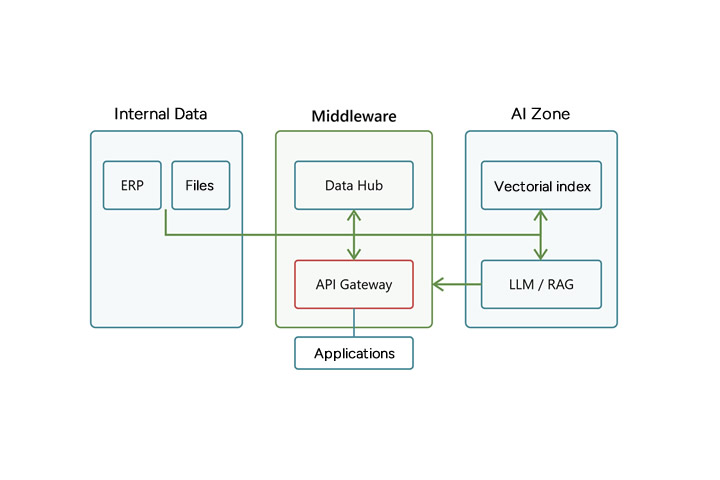
Architecture decides which components are (still) custom-developed or implemented, which services run in the cloud or on-prem, and where we keep the company's data and the control of integrations with other applications.
In the AI Architecture 2026 guide series, OPTI details a hybrid architecture: specialized AI services, connected through middleware to existing data systems. The goal is to use AI capabilities without delegating control over deterministic business rules.

Recommended resources (download here):
- Google Cloud - Choose your agentic AI architecture components
- Google Cloud - Generative AI with RAG
- OPTI - AI Architecture for B2B in 2026
- OPTI - Architecture diagrams - Guide 1
2. Tracking business KPIs
A software project can pursue very different objectives if the people building it do not connect to the company's priorities. For example, in an ecommerce project, increasing the conversion rate, the average order value, the commercial margin or stock turnover are different objectives. They change what you need to deliver and therefore what you ask Claude Code for, even without complete specifications from the client.
In the diagram below, an AI engine estimates the purchase probability of several product bundles. The final offer, however, is conditioned on respecting a minimum commercial margin. So the developer has to obtain and understand the company's objectives and rules.

The same indicators must be measured before and after implementation to evaluate the real impact of the solution, so developers become business analysts.
Recommended resources (download here):
- Google Cloud - ROI of AI 2026: From tokenmaxxing to ROI.
- Google Cloud / DORA - ROI of AI-assisted Software Development.
- OPTI - Guide 1: Recommendations, upsell and rules
- OPTI - Next Best Action in B2B with Google Cloud and CRM.
3. Cybersecurity and resilience
Obviously, the growing amount of fast-written code and of AI agents with access to data requires an additional security effort.
Security must be addressed both in the development process (code review, dependency checks, permission testing) and, above all, in the operation of the resulting systems.
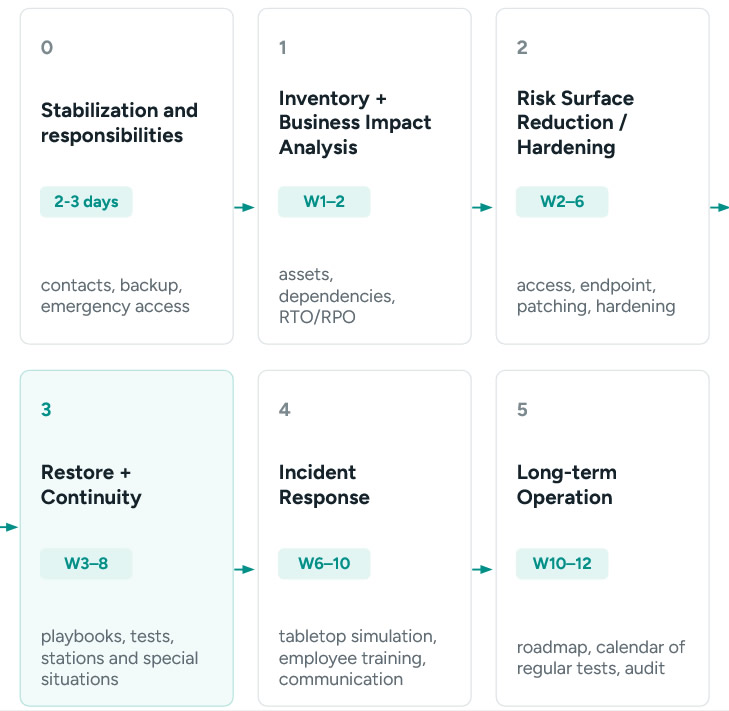
At OPTI we have documented a six-phase cyber resilience program that can be applied over 12 weeks: from infrastructure inventory and Business Impact Analysis to hardening, restore tests, incident response and recurring operation.
Recommended resources (download here):
- Google - Secure AI Framework (SAIF).
- NIST - Secure Software Development Framework (SSDF).
- OPTI - Backup ≠ Continuity. A 12-week cyber resilience program.
I invite you to explore the library of technical resources and whitepapers, which we will keep updating throughout 2027.
AI Coding in 2026 in numbers - the Sonar study
84% say AI helps them ship features faster. | 53% spend more time reviewing code than writing it, compared to 18% before AI. |
37% believe unclear requirements and priorities are the main causes of inefficient work. | 43% report a lower-than-expected return on their AI coding investment. |
23% have specific rules or automated checks defined for AI code. | 94% do not fully trust AI-generated code. |
The Sonar study was conducted in September 2026 among 1,026 software developers / engineering managers.
Technical diagrams as input for Claude Code / Codex and for AI agents
In an upcoming guide we will show how we turn OPTI diagrams into an integration specification, together with data models / API contracts. They can then also become part of the working documentation of AI agents.
Until then, you can read What the OKF format is and how to split company data and rules into markdown files for AI agents.