



Benefits delivered by the platform
1
Agent connected separately to each system
Increases the number of integration points, permissions, and places where logic has to be maintained.
2
Autonomy without control
An agent that can act without rules, audit, and thresholds can create operational or commercial cost.
3
Cost and results are hard to track
As the number of agents grows, we need to know what ran, what it cost, and what result it produced.

Designed for AI agents connected to real data, rules, and actions
A useful business agent needs to know not only what it can read, but also what it is allowed to decide, what it can execute, and when it has to ask for validation.
- Accesses relevant data from ERP, CRM, and other authorized systems
- Uses deterministic rules where the outcome must not be freely interpreted
- Can call explicitly defined tools, APIs, and actions
- Separates recommendation from automatic execution and from actions that require approval
- Keeps context, permissions, and traceability for every important action
- Allows multiple agents or roles to be composed on the same AI Sales architecture
Key features
Specialized agents
Quoting, replenishment, pricing, support, analysis, or prospecting.
Shared data layer
The same controlled integration with ERP, CRM, WMS, documents, and other sources.
Tool use
Each agent gets only the tools it needs for the task.
Human-in-the-Loop
Analysis, recommendation, draft, approval, or execution.
Observability
Runs, status, tools, errors, feedback, and outcome.
Cost control
Estimated cost per agent / workflow and optimization.
MODULE PREVIEW
Same agent architecture, different business decisions
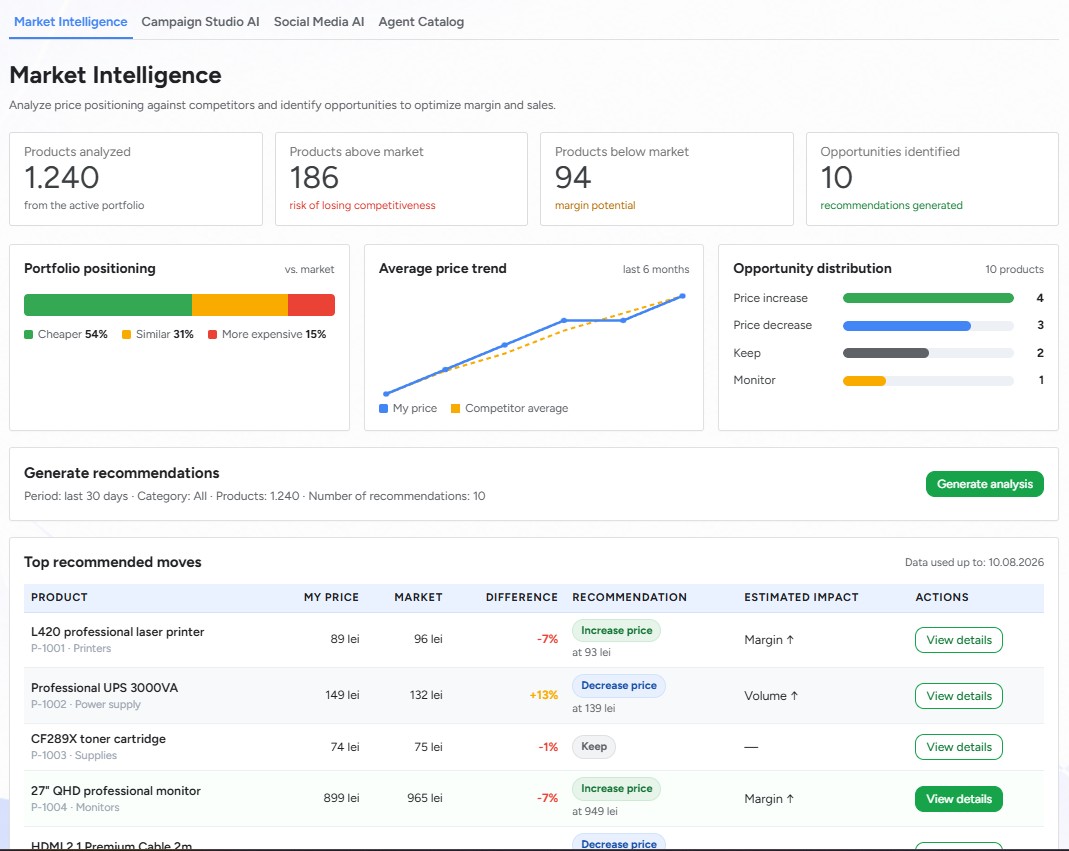
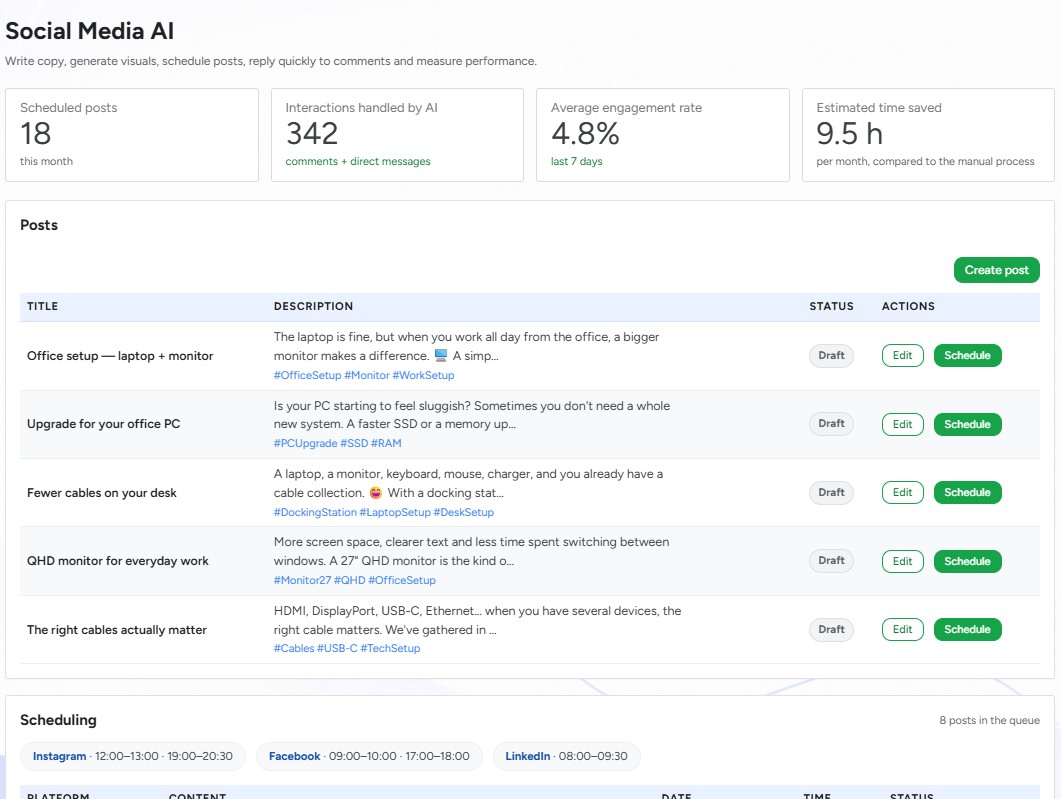
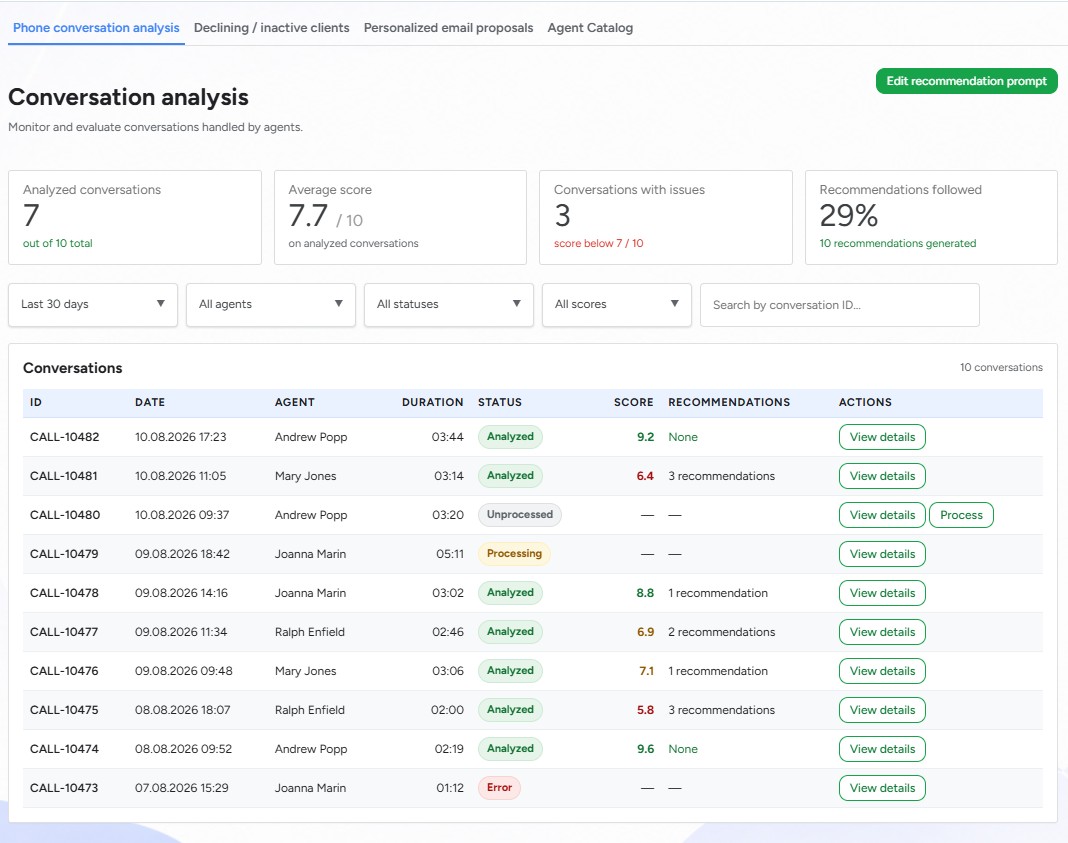
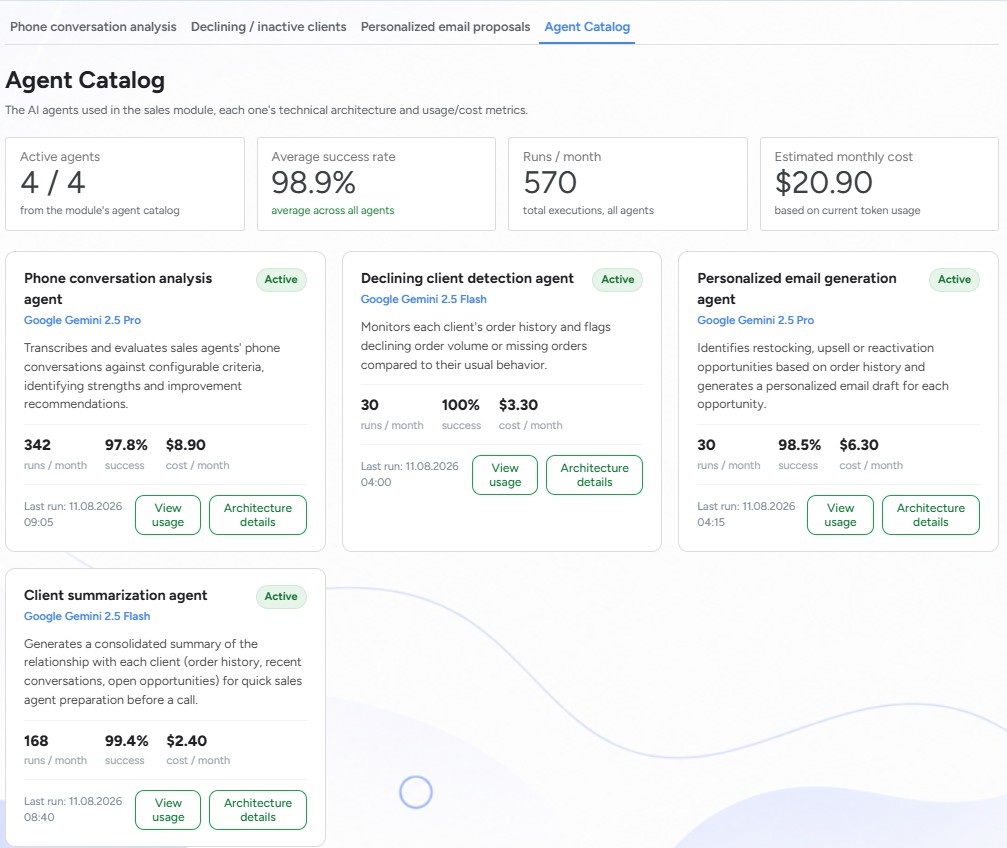
A Replenishment Agent and a Pricing Agent run different workflows, but share the same needs: authorized data, a clear objective, tools, rules, permissions, logs, cost control, and a boundary between recommendation and execution. That is why we treat agents as a cross-cutting capability.
- authorized data and rules
- tools limited to the role
- logs and observability
- Human-in-the-Loop for high-impact actions
THIS IS A MODULE OF AI SALES 2.0 PLATFORM
Want to see the whole platform?
See all nine modules and the available packages. Contact us for a demo.
Simplified architecture
From data to controlled action
ERP and CRM remain the source of truth for operational values. AI Sales adds interpretation, rules, prioritization, and workflow on top of existing systems.
ERP · CRM · WMS · docs
AI Sales Decision Layer
Agent workflow
Tool + rules + validation
Human review / action
Logs · cost · feedback
Benefits delivered by the platform
1
AI can move from answering to acting
The agent can consult data, use tools, and prepare or execute steps defined in the process.
2
Context stays shared across modules
The customer, product, rules, and permissions don't have to be rebuilt separately for each agent.
3
Autonomy can be controlled per action
Reading data, recommending, drafting, and executing can have different levels of permission and approval.
Comparison
Automation, AI agent, or a group of agents?
The choice should start from the complexity of the decision, not from a desire to use an agent. AI Sales can combine all three levels.
| Model | Automation | AI Agent | AI Sales agent group |
|---|---|---|---|
| Best fit when | The rule is known | Context needs to be interpreted | The task has multiple stages / specializations |
| Example | stock < threshold → alert | declining customer → recommendation | end-to-end prospecting |
| Cost | Low and predictable | Variable by run | Higher; justified only if it delivers value |
| Control | Deterministic | Rules + tools + approval | Orchestration + permissions + observability |
A BONUS FOR YOU
Why AI Sales 2.0: the Growth Platform Built on the Award-Winning OPTI Architecture
AI Sales 2.0, available starting July 2026, is an extended platform in which the company's data about products, customers, orders, prices, and stock can be used by all its departments. The modules bring artificial intelligence into optimizing sales, purchasing, warehousing, and performance oversight by management
Receive the material
Fill in the form and we will send the material to your email.
ADDED IN AI SALES 2.0
How the AI Sales agent layer works
AI agents do not replace the eight modules. They connect them and enable a controlled move from information to action, using the same data, rules, and permissions.
- Observe — they read events and context from ERP, CRM, documents, and applications.
- Reason — they combine data, rules, and tools to prepare the next step.
- Act — they can create tasks, drafts, notifications, or permitted operations.
- Ask for approval — they stop the flow when the decision needs human control.
- Leave an audit trail — sources, steps, and actions can be traced.
Agents connect all AI Sales modules
Intelligent B2B Order Taking & Technical Sales
Takes over the identified account and tells the agent which action is worth taking next.
See the module
Conversational Analytics & Business 36
The agent queries the data and can move on from explanation to an action or an investigation.
See the module
Sales Operations & B2B Approval Workflows
The agent orchestrates the steps between CRM, ERP, and people, within the defined permissions and thresholds.
See the module
It also works across Stock, Price Intelligence, NBA, Document Intelligence and Lead Generation.
Want intelligent quoting?
See the module in action
The AI Sales 2.0 platform includes nine modules. Book a 30-minute presentation.
Book a 30-minute technical assessment
We look at the problem, the systems involved and which KPIs can be reached.
You get a solution quickly.
See OPTI's delivery models and guarantees →
Last updated: 6 November 2026
×
![]()