

In B2B companies, departments have different rules and risks, for example between quoting, procurement and management.
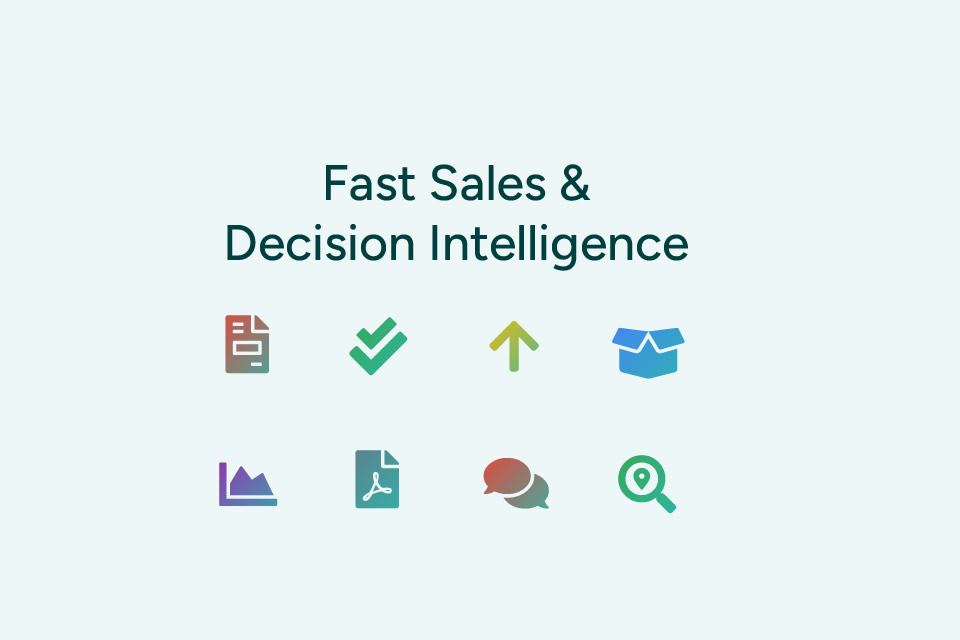
That is why we extended AI Sales 2.0 into a platform with eight specialised applications and a shared layer of AI agents. Each module delivers measurable benefits for one problem, and the AI agents combine company data with Google Cloud technologies, without you having to replace your current ERP or CRM.
The eight applications for concrete problems
1. AI Quoting
Why? Finds the right products and prepares quotes quickly using ERP data
Concrete situation: The customer asks for a pump, but uses a different name than the one in the ERP. The sales rep searches by code, checks the specifications, then the price and the stock.
2. Operations and approvals
Why? Manages discounts, approvals and commercial workflows.
Concrete situation: The sales team prepares a quote and asks for a 12% discount. For that customer, the commercial rule allows 8%. The difference has to be approved by a manager.
3. Next Best Action
Why? Recommends which customer the sales team should contact and estimates upsell/cross-sell, including based on purchasing rhythm.
Concrete situation: A customer regularly buys consumables. They usually come back after about 45 days. On day 42, the sales team can receive a suggestion to contact them.
4. Stock and procurement
Why? Anticipates product demand and proposes replenishment
Concrete situation: We have 100 units of a product left. We sell 12 per day on average. A supplier order arrives in 14 days, and 40 units are already reserved.
5. Price Intelligence
Why? Compare products and prices across competitors or suppliers and see how the market evolves
Concrete situation: One competitor sells the product per unit. Another sells it in sets of four. One supplier has it in stock, the other shows delivery in three weeks. Price Intelligence has to compare them on a uniform basis.
6. Document Intelligence
Why? Searches and extracts information from technical documents, including through assistants/chatbots
Concrete situation: A technician looks up the maximum pressure of a pump. They find two datasheets: one for the old version, another for the current model.
7. Conversational analytics
Why? Answers questions about sales, stock and customers from company data
Concrete situation: The manager sees more orders, but lower revenue. They ask whether the average order value, the product mix or the share of certain customers has changed.
8. Lead Generation & Account Intelligence
Why? Identifies and prioritises companies based on public data and commercial signals.
Concrete situation: A company posts three Data Engineer job openings. For a cloud services provider, this can signal a new project or a team expansion.
These simplified examples illustrate the problems addressed by the AI Sales 2.0 modules.
What do the AI agents that connect them do?
The cross-cutting module is the AI agents layer. The agents can query authorised data to prepare actions across the ERP, the CRM and the AI Sales 2.0 modules.
Why? The company sets the limits of the AI: the contract price, availability, discount limits and approvals. This approach comes from OPTI's experience: clients want safe AI with explicit limits.
Concrete situation: A customer asks for 40 products. The AI agent identifies the products, checks the stock and builds a draft quote. One product is not available. The AI agent looks for an alternative, but it exceeds the price allowed for that customer. The AI stops and requests approval.
Discover the cross-cutting module
Instead of a single agent that does everything, the OPTI architecture builds specialised applications that solve the client's problems. You can start with quoting, stock or commercial analysis only, depending on your business.